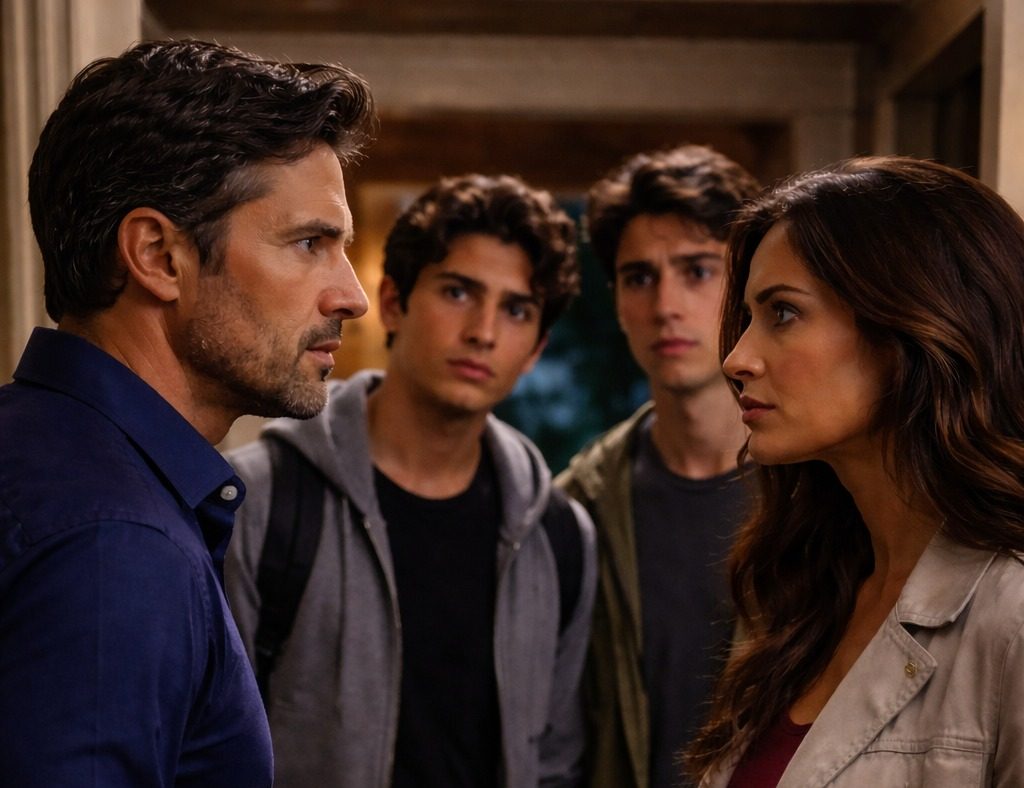
Millonario se divorcia de su esposa sin saber que está embarazada: 18 años después, ella lo llama

Millonario se divorcia de su esposa sin saber que está embarazada: 18 años después, ella lo llama
Dieciocho años después de divorciarse de su esposa, sin saber que estaba embarazada, un millonario recibe una llamada de ella a medianoche. Le tiembla la voz al contarle la verdad. Tiene gemelos, y ahora esos niños están en peligro. Sin pensarlo dos veces, toma sus llaves, lo deja todo y sale corriendo. La mejor historia jamás contada para mi hermosa familia. Empecemos con el amor.
Alejandro Rivera había forjado su fortuna con riesgos calculados, pero apostar por la duda en lugar de la confianza le costaría todo lo que valía la pena vivir. La mañana comenzó como cualquier otra en su vida juntos. Valeria Morales se movía por el dormitorio con esa gracia particular que había captado la atención de Alejandro al principio; su piel morena brillaba bajo la luz matutina que se filtraba a través de las cortinas de seda.
Tarareaba algo suave, una melodía de su infancia cuyo nombre nunca recordaba, mientras doblaba sus camisas con precisión. “No tienes que hacer eso”, dijo Alejandro desde la cama, mirándola con la satisfacción que la mayoría de los hombres buscan toda la vida. “Tenemos gente para eso”, respondió ella, girándose con una sonrisa radiante y provocadora.
“Tus empleados se doblegan como si estuvieran enojados con la tela. Yo me doblego como si te quisiera”. Así era Valeria. Tenía una habilidad especial para convertir momentos cotidianos en poesía, para hacer que una mansión se sintiera como un hogar en lugar de un monumento. Cuando Alejandro la conoció en una recaudación de fondos para la comunidad, llevaba un vestido que probablemente costaba menos que su reloj.
However, she was the most magnetic person in the room, not only because of her beauty, though it was dazzling, but because of something deeper. She listened when people spoke. She laughed with her whole body. She saw beyond his wealth to the man tired of being seen as just a bank account with a pulse. Her marriage scandalized her circle.
His lawyer had said the words “prenuptial agreement” 17 times in a single conversation. His mother suggested he was having a crisis, but Alejandro had never been so sure of anything. Valeria wasn’t interested in his money. She worked with women in crisis, helping them rebuild shattered lives, and came home with stories that reminded him the world was bigger than quarterly returns and real estate purchases.
“What are you thinking about?” she asked, catching him looking at her. “That I’m the luckiest man alive.” “Flattering,” he said, moving closer to the bed and kissing her forehead. “I have a community meeting this morning. Budget discussions for the new shelter program. Take the car.”
“Take the chauffeur, please.” She laughed. “Alejandro, I’m going six blocks. I’ll walk like a normal human being.” Normal. That word again. Valeria had a way of keeping him grounded, of reminding him that wealth was a tool, not an identity. She had refused to quit her job when she got married, despite his offers to finance any project she wanted.
“I need to be useful,” she explained. “Not comfortable, useful.” He left for his office an hour later, kissing her at the door as he had done thousands of mornings before. She had no way of knowing that it would be the last morning that simple gesture felt innocent. He resigned at noon. His assistant brought him lunch, miserably uncomfortable.
It arrived by courier, marked confidential. Inside were photographs, not explicit, but damning in their intimacy. Valeria was sitting in a café with a man Alejandro didn’t recognize. The angle suggested they were holding hands on the table, although the image was grainy enough to be ambiguous.
Another photo showed them walking together in a park, the man’s hand seemingly on her lower back. A third captured them outside a hotel, talking very closely. Alejandro’s hands trembled. The enclosed letter was typed. Anonymous. Your wife is not who you think she is. These meetings have been going on for months.
I thought I deserved to know before I looked like a complete idiot. His chest tightened. He told himself there had to be an explanation. Valeria had never given him a single reason to doubt her, but the photos sat on his desk like accusations, and his mind began to construct narratives he didn’t want to believe.
He called his partner, Javier Torres, who arrived immediately. Javier looked at the photos and slowly shook his head. “Alejandro, I hate to say it, but I’ve seen this before. My brother went through the same thing. Could there be an explanation?” “Of course there could, but you have to ask yourself something.” Javier leaned closer, lowering his voice. “A woman from her background suddenly living in luxury, without a prenuptial agreement to protect her.”
And if it was all strategic, what if she’s been manipulating you from the start? The poison worked slowly. Alejandro tried calling Valeria, but she didn’t answer. She was in her meeting with her phone on silent as usual, but his mind, now infected by suspicion, interpreted the silence as evasion. More photos arrived the next day.
Then a copy of a restaurant receipt with a handwritten note at the end. Tonight was perfect. The handwriting seemed similar to Valeria’s, though Alejandro couldn’t be sure. He stopped sleeping, stopped eating, hired an investigator who returned with reports of regular meetings, always in discreet locations, always with the same man.
The investigator couldn’t confirm infidelity, but he couldn’t rule it out either. When Alejandro finally confronted Valeria, he’d been awake for 40 hours, stewing over a betrayal he’d convinced himself was real. “Who is he?” His voice was cold, detached even from himself. Valeria looked up from her book, confused. “Who’s who? The man you’ve been seeing.”
Don’t lie to me, I have photos. The color drained from her face, not from guilt, but from social media. What are you talking about? He threw the envelope at her feet. She picked it up slowly, her hands trembling as she looked at the pictures. When she looked up, tears were in her eyes. Alejandro, this is Rafael. He’s a social worker I collaborate with on the shelter project.
These photos make me look like something I’m not. So why didn’t you tell me? I told you. I’ve mentioned Rafael dozens of times. You never ask for details because you’re not interested in my work. You smile, nod, and go back to your phone. The precision of that observation should have stopped him, but pride, that ancient poison, was already coursing through his veins.
So, is it my fault you’re sneaking around? I’m not sneaking around. We have public meetings about public projects. Alejandro, look at me. You know me. You know I never know anything anymore? His voice broke. All I know is that my wife has been seeing another man for months, keeping it a secret.
And now there are photos of you two looking very comfortable together. Because we’re friends, colleagues. That’s what adults do, love. We work together without it implying anything sordid. But he couldn’t hear her. The doubt already had deep and thorny roots. The divorce proceedings were brutal. Alejandro had resources, contacts, lawyers who could make things disappear or appear as needed.
Valeria had her dignity and the truth, neither of which carried much weight in a legal battle. She tried to reason with him one last time, appearing unannounced at his office. “Alejandro, please, just listen to me for five minutes without your lawyers or your pride in the room. I have nothing to say to you. So just listen.” Her voice cracked.
I love you. I’ve only ever loved you. I don’t know who sent those photos or why they’re trying to destroy us, but I swear on everything sacred that I was never unfaithful to you. He looked at her and for a brief moment saw his wife, the woman who lovingly folded his shirts, who turned the mansion into a home, who laughed with her whole being.
But then Javier’s voice echoed in her head, women from her background suddenly living in luxury. “I want you to leave by Friday,” Alejandro said hollowly. “Take your clothes, everything else stays. Alejandro, Friday.” She left the office, and that should have been the end of it. But that night, while Alejandro was alone in his house, which suddenly felt cavernous, Valeria returned one last time.
She stood in the doorway, small and devastated, wearing the same dress she’d worn the night he proposed. “I came to tell you something,” she said softly, “not to change your mind, because clearly it’s made of stone now, but because it deserves to know the truth about what you’re throwing around. I don’t want to hear it.”
I’m tired of fighting. I’m tired of begging. I’m leaving, Alejandro. I’m leaving you, your mansion, your suspicions, and your pride. But I want you to know that years from now, when you finally discover you were wrong, when you learn there was never anyone else, you’ll have to live with what you destroyed. She took off her wedding ring, placed it on the marble floor between them, and left.
Alejandro stood there listening to her footsteps echo through the house. He heard the front door open. He heard it close. He froze, staring out the window as she walked barefoot down the long driveway, having taken off her heels. One hand pressed against her stomach in a gesture he didn’t understand. Behind her, his mansion glittered with lights.
Ahead lay only darkness. And at that moment, Alejandro Rivera, who had built an empire on calculated risks, realized too late that the only bet that truly mattered was the one he had just lost catastrophically. But what he didn’t see, what he couldn’t possibly know, was that Valeria Morales was walking away carrying more than just her broken heart.
She carried two pieces of himself that would grow into the only second chance he would ever have. The women’s shelter was filled with industrial soap and resignation. Valeria Morales sat on a narrow bed in a room shared with five other women. Her small backpack contained everything she owned now: three changes of clothes, a water bottle, her expired social work certification documents, and the pregnancy test she had taken in a gas station bathroom.
Two pink lines, two lives depending on her. Two reasons not to fall apart. The woman in the next bed was older, with kind eyes and scars on her arms that told stories Valeria didn’t need to hear. “First time?” she asked. “First time homeless.” “No, first time broken.” The woman nodded understandingly.
The difference is that what’s broken can heal. You’ll see. Valeria’s body had other plans. Morning sickness arrived with a vengeance, making it impossible to hide her condition. The shelter coordinator, a woman of steel named Rosa, called her to her office. “Are you pregnant?” It wasn’t a question. Valeria nodded.
The father in the photo. No. Child support. No, Rosa studied her for a long moment. You know you have options, resources. This doesn’t have to be your path. It’s already my path, Valeria said softly. I’m going to have them. Dem feels like more than one. I don’t know why. Just a feeling. Rosa’s expression softened slightly.
So, you need to start planning. This place has a two-month limit. After that, she’s on her own. Valeria found a job at a textile factory where they didn’t ask questions and the pay was in cash. The work was exhausting, 12-hour shifts operating machinery that turned fabric into cheap clothes for discount stores.
Her hands grew calloused. Her back ached constantly. Her body swelled with pregnancy while she was at her post, drinking water when the supervisors weren’t looking, hiding her growing belly under shirts. The other workers, mostly immigrant women with their own stories of survival, looked after her with silent solidarity.
They gave her extra food from their lunches. They covered her up when she had to vomit in the bathroom. They didn’t ask questions because they understood that some stories were too painful to tell. At six months, the ultrasound technician at the free clinic looked at the screen in surprise. It’s twins. Valeria’s breath caught in her throat.
Twins. Two children. The technician showed her the screen indicating two distinct heartbeats. Two separate forms nestled in the darkness of her womb. Boys, the technician confirmed. Both appear healthy. Valeria left the clinic dazed, her hands pressed against her belly where Alejandro’s children were growing.
She should have felt anger. She should have wanted to call him, demand that he face the consequences of his accusations, but she only felt a fierce and protective love for those two beings who hadn’t asked to be born into chaos. That night she silently named them Matthew and James, prophets who had endured hardships and emerged faithful.
She needed that faith. Now the birth was solitary. Rosa took her to San Rafael General Hospital when the contractions started, leaving her with a quick squeeze on her shoulder. You’re stronger than you think. Valeria didn’t feel strong. She felt terrified and alone, clinging to the railings as her body tore through, bringing life into the world.
Without a partner holding her hand, without family in the waiting room, just her and two babies fighting for their lives. Mateo arrived first, shouting with indignation. Santiago followed minutes later, quieter, his eyes seemingly observing the fluorescent lights with solemnity. “Twins,” said the exhausted nurse, placing them on Valeria’s chest.
“Congratulations, Mom.” Valeria gazed at their tiny faces and felt something shift permanently within her. These children would never know abandonment, never feel unwanted. She would build them a life from scratch, and that would be enough. The following months were a blur of sleepless nights and relentless activity.
Valeria found a subsidized apartment in the La Esperanza neighborhood, where gunshots sometimes punctuated the night. It had one bedroom, cracked linoleum, and windows that didn’t close properly, but it was theirs. She went back to school, taking online night classes while the twins slept, earning her degree in social work while breastfeeding during lessons, typing papers with one hand while rocking the crib with her foot.
The children grew up. Mateo was all smiles and easy laughter, reaching for everything with his chubby little hands, fascinated by shapes and patterns. Santiago was more thoughtful. His gaze followed movements, his little fingers clinging to the fabric as if he understood that letting go meant falling. Valeria talked to them constantly, narrating her life as if they could understand.
Now we’re going to the store. We’ll walk because the bus takes an hour. It’s good exercise. Fresh air. Look at the red and gold leaves. Beautiful things are free. She refused to give in to bitterness. Some nights, alone after the children had fallen asleep, she felt the weight of what Alejandro had thrown away, but she never spoke his name in front of them.
She never poisoned their minds with her sorrow. Instead, she told them a story, a different one, a fairy tale. Once upon a time, there was a king who loved a queen. Together they built a beautiful kingdom. But an evil wizard convinced the king that the queen had betrayed him, and the king believed the lie. So the queen had to leave the kingdom, and she was very sad, but she took with her the most precious gifts the king had given her, though he didn’t know it.
And she nurtured those gifts with all the love they both should have shared. What happened to the king? Mateo asked when he was old enough to understand the story. The king lived alone in his castle, wondering if he had made a terrible mistake. Santiago’s voice was always softer, more measured. Valeria smoothed her hair, choosing her words carefully.
He made a decision based on fear instead of love, and fear always costs more than people realize. The children grew up to be extraordinary despite the poverty that surrounded them. Mateo excelled at anything involving numbers, solving puzzles meant for older children. His mind worked with patterns and sequences that amazed his teachers.
Santiago devoured books, writing stories in cramped handwriting on any scrap of paper he could find. His observations about people and their motivations were disturbingly perceptive. Valeria worked several jobs: social worker by day, teaching community classes in the afternoon, cleaning offices late at night while children did homework in break rooms.
She was always exhausted, worn out, but she never let them see that she was breaking down. “Why do you work so much, Mom?” Mateo asked once, watching her put ice on her swollen feet. “Because you two are worth every tired bone in my body.” “The king of the story,” Santiago said softly.
Did he ever find out about the gifts? Valeria looked into her son’s eyes, seeing in them a reflection of the man who had discarded her. “I don’t know, darling. Some stories don’t have an ending yet.” But she knew one thing with absolute certainty. Alejandro Rivera had no idea what he had lost. And if life had any justice, he would spend the rest of his days drowning in that ignorance.
The universe, however, had other plans. Plans written in genetic code, waiting in the shadows, counting down the days until a moment when past and present would collide with the force of two young hearts beginning to fail simultaneously. Alejandro Rivera stood in his studio, looking at architectural plans that should have excited him.
Another tower, another development, another monument to success that felt hollow inside. His assistant gently knocked on the door. “The contractors are here for the final approval meeting.” “Cancel it, sir. They’ve been scheduled for weeks. Cancel it.” His voice was flat, distant. “Reschedule for whenever.”
I don’t care. The assistant left, and Alejandro returned to the window, gazing at the immaculate gardens that resembled a cemetery more than a garden. Everything perfect, everything dead. The mansion had become a mausoleum. Thirty-two rooms, most untouched, gathering dust behind closed doors. The cleaning staff arrived weekly, moving like ghosts, careful not to disturb anything in the master bedroom, especially the reading chair by the window.
It had been Valeria’s chair. She spent her mornings there with her coffee and whatever book had caught her eye, the sunlight turning her skin bronze, her expressions changing with the words she read. Alejandro had never moved it, never allowed it to be cleaned. Sometimes he would find himself standing in the doorway at dawn, half expecting to see her there, her feet tucked beneath it.
That faint smile he wore when he read something beautiful. But the chair remained empty. His sister Elena was the only one who regularly invaded his solitude. She would arrive unannounced, using the key he had made the mistake of giving her, and find him in his study pretending to work. “You look like death.” “Good morning to you too.”
She sat down uninvited, studying him with the brutal honesty only siblings possess. “When was the last time you ate a real meal? Sleep for more than a few hours? Or climb out of this grave you dug for yourself? I’m fine. You’re not fine. You haven’t been fine since you threw away the best thing that ever happened to you.”
Alejandro’s jaw tightened. “I don’t want to talk about it.” “Of course not, because talking about it would mean admitting you were wrong.” Elena leaned forward, her voice sharp. “Did you ever find any proof, Alejandro?” “After all these years, what?” The photos were circumstantial at best.
You never found hotel receipts, never love letters, never a single piece of concrete evidence because there wasn’t any to find. You don’t know that. Neither do you, but you destroyed your marriage anyway. He wanted to argue, but the words died in his throat because Elena was right. Over the years, in moments of terrible clarity, Alejandro had questioned everything.
She had hired investigators long after the divorce, trying to find something, anything, to justify what she had done. They found nothing. Rafael Gómez, the man in the photos, was exactly as Valeria had described him. A happily married colleague with three children, no history of affairs, no connection to Valeria beyond professional collaboration on hostel projects.
The anonymous letters had stopped after the divorce. The photographer was never identified. Alejandro had traced the photos back to a disposable mailbox that led nowhere. And slowly, over months that turned into years, a terrifying possibility had taken root.
He had been deceived. Someone had wanted to destroy his marriage, and he had handed them the weapon. Javier Alejandro confronted the dirty woman after discovering financial irregularities. “Did you send those photos?” Javier smiled coldly and calculatingly. “It matters now. You’re free of her. Can you focus on what’s important?” Alejandro cut all ties that day, but the damage was permanent.
Valeria was gone, and he had no idea where she’d gone. He tried to find her, hired the best investigators money could buy, but Valeria Morales had vanished completely, without a trace, no forwarding address, nothing. It was as if she’d been erased from existence. The videos were still on his phone.
He watched them late at night, the whiskey burning his throat, her laughter filling the empty studio, their wedding, their honeymoon, everyday moments of her cooking breakfast, telling bad jokes, dancing in the kitchen to music only she could hear. “You’re watching them again,” Elena said, recognizing the hollow look in his eyes.
I can’t help it. So do something about it. Hire better investigators. Put up posters. Something other than slowly dying in this house. What for? Even if I found her, what would I say? Sorry for ruining your life based on lies. Sorry for throwing you away like trash. She’d be right if she spat in my face.
Maybe. But at least you would have tried. Alejandro said nothing because the truth was more pathetic. He was afraid. Afraid to confirm that she had moved on, found happiness, built a life without him. Afraid to see in her eyes the total absence of feeling that would be worse than hatred.
So he stayed in his mansion, surrounded by wealth that meant nothing, attending meetings out of habit, making decisions that affected thousands while being unable to manage his own existence. His bedroom was the worst. He kept it exactly as it was. Her clothes still hung in the closet. Her books remained on the nightstand.
Her pillows were still on her side of the bed, and Alejandro never touched them, sleeping on his side, staring at the vast empty space that might as well have been the Grand Canyon. “You didn’t lose her,” Elena said, standing to leave. “That would imply it was beyond your control. You threw her away, Alejandro. You chose pride over trust. That’s worse than loss.”
That’s willful destruction. After she left, Alejandro walked through the mansion, truly seeing it for the first time in years. The dining room where they never ate, too formal, too cold. The living room with furniture no one sat on, the kitchen that prepared food for one person in a space designed for families.
His footsteps echoed on the marble floors, and he realized Elena was right. This wasn’t a home; it was a monument to absence, a shrine to everything he had destroyed. In the garage, his collection of vehicles sat unused: sports cars, luxury sedans, a vintage motorcycle he’d bought thinking it would make him feel young again.
He couldn’t remember the last time he’d driven one. He picked one at random, some expensive machine, and drove aimlessly, just moving. The streets blurred by, and he found himself in neighborhoods he’d never seen before, where children played in the streets and families gathered on porches, where poverty and joy somehow coexisted.
He stopped in a park, watching a woman push two twin boys on swings. They laughed, shouted with delight, while their mother smiled wearily and lovingly. Alejandro felt something break inside his chest that could have been his life. Should have been his life. Children, laughter.
A purpose beyond the accumulation of meaningless achievements. He returned home as darkness fell, back to his mansion that glittered with lights but offered no warmth. Inside, he poured himself a whiskey he wouldn’t drink and stood at his study window, staring into nothingness. Tomorrow would be the same, and the next day, and the next—an endless succession of identical moments stretching toward a grave he would reach having accomplished nothing that mattered.
Alejandro Rivera, master of the material world, stood alone in his dusty empire, wondering how a man could be so rich and so broken at the same time. The answer, of course, was simple. He had gambled everything on pride and lost the only thing worth keeping. And somewhere in the world, his ex-wife was either flourishing or drowning, and he would never know because he had relinquished the right to ask.
But the universe keeps accounts that humans cannot see. And Alejandro Rivera’s debt, accumulated over years with interest paid in regret, was about to come due in the form of a phone call that would shatter what remained of his carefully constructed numbness. The gym smelled of teenage sweat and ambition.
Santiago Morales moved across the court with fluid grace, his movements economical and purposeful. Community basketball wasn’t a competition for him; it was rhythm. The way the game forced him to be present, far removed from the stories that always ran through his head. Mateo watched from the stands, simultaneously timing his brother’s runs and calculating optimal angles for three-point shots.
His notebook was filled with equations and observations, transforming play into mathematics, finding patterns in chaos. Valeria sat beside him, proud and tired, having just finished a night shift at the crisis center. Watching her children had become her meditation. These two extraordinary young people who had grown from nothing to become everything.
The ball arced toward Santiago. He caught it mid-run, pivoted, and then stopped. Just stopped. His hand went to his chest. His face changed. The ball fell from his fingers, bouncing, forgotten, as Santiago’s knees buckled. Valeria moved before it hit the ground. Mother’s instinct faster than thought.
He reached him as he collapsed, his body convulsing, his eyes rolling back. “Someone call an ambulance.” His voice cut through the sudden chaos, firm despite the terror that clawed at his throat. Mateo was already on the phone, hands trembling, but his voice clear, giving the emergency operator his brother’s location and symptoms.
The ambulance arrived in what felt like seconds and centuries at the same time. The paramedics surrounded Santiago, asking questions that Valeria answered on autopilot while her mind screamed denial. This wasn’t happening. Her son was healthy. Her son was strong. It was a mistake, an anomaly, something explainable and irreparable.
The emergency room at San Rafael General Hospital was a controlled pandemonium. Doctors shouted orders, machines beeped urgently. Santiago was taken behind swinging doors that slammed shut in Valeria’s face, separating her from her son, and she felt a primal rage against the barriers, against her powerlessness, against the universe, for daring to threaten her child.
Mateo was by her side, silent, his mind already calculating probabilities he didn’t want to face. “Are you his mother?” A doctor appeared, young but exhausted, with the expression medical professionals adopt when delivering bad news. “Yes.” “What’s wrong with my son?” “We’ve stabilized him, but I need to run some tests.”
Has he ever had chest pain? Shortness of breath, dizziness? No, nothing. He’s healthy. He’s athletic. The doctor nodded, but his eyes said he’d heard that before. I’ll have more information soon, but Mrs. Morales, be prepared. Your son’s heart rhythm is severely irregular. This is significant. The tests took hours.
Valeria and Mateo sat in a waiting room where time moved differently, stretching and contracting, where every door that opened could bring salvation or devastation. Finally, an older cardiologist appeared, with gray hair and eyes that had seen too much death. He sat down, which was never a good sign.
Her son has hypertrophic cardiomyopathy. It’s a genetic condition in which the heart muscle thickens abnormally, making it difficult for the heart to pump blood. In Santiago’s case, it’s advanced; he’s in acute heart failure. The words landed like physical blows. Valeria’s hand found Mateo’s and squeezed it tightly.
What does that mean? Treatment, surgery. It means his heart is functioning at a fraction of its normal capacity and is deteriorating rapidly. Standard treatments aren’t options here because of the specific genetic markers involved. We need to consider cell therapy, a stem cell transplant from a biological progenitor to rebuild the damaged tissue.
Valeria processed the information, her medical training kicking in despite the panic. “My cells, test mine.” “We will, but there’s something else.” The cardiologist looked at Mateo. “This condition is hereditary. Since you’re twins, there’s a very high probability that you have it too.” Mateo’s face paled. “I feel fine now, but if you have the same genetic markers, your heart is probably in the early stages of the same deterioration.”
We need to run tests on you immediately. The next few hours were a nightmare of needles and scanners. Mateo was pricked, palpated, examined, his body scrutinized in search of the invisible killer hidden in his genetic code. The results confirmed the worst fears. Both twins carried the mutation.
They were both dying, just at different rates. Valeria’s results came after an agonizing wait. The cardiologist’s face said it all before he even spoke. “I’m sorry, Mrs. Morales. Your cells aren’t a match. There’s a chromosomal mismatch that makes you unsuitable as a donor. It’s rare, but it happens.”
Then find another donor. There has to be a registry, someone compatible. The genetic markers are too specific. They inherited it from their father. We need their cells. The DNA has to match almost exactly for this therapy to work. The room tilted. Valeria heard the words, but couldn’t process their implications.
“The biological father,” the cardiologist continued gently. “He’s available. Would he be willing to undergo testing?” Mateo and Santiago, lying in adjacent beds in intensive care, looked at their mother with questions they had never asked, but had always felt. “We have a father.” Santiago’s voice was weak, confused.
“You always said he left,” Mateo added. “That he left before we were born.” Valeria had never lied to her children; she had only omitted the parts too painful to explain. And now those omissions had become a crisis. “Their father doesn’t know you exist,” she said softly.
She never knew she was pregnant. “We separated before I found out. Then find him.” Santiago’s monitor beeped urgently, his stress affecting his already compromised heart. “Please, Mom, I don’t want to die.” Those words broke something fundamental in Valeria: her son pleading for life from a man who had destroyed hers.
That night, after the boys finally fell asleep under sedation, Valeria sat in the hospital chapel. Empty pews, dim lighting, the weight of an impossible choice. She had sworn never to contact Alejandro Rivera again. She had built a life specifically so that she would never need him.
She had raised two children to be whole without a father, because fathers could be poison, they could be absence, they could be what ruins you. But now those children were dying, and their cure lay in the genetics of the man who had discarded her like trash. Her phone rested in her lap, his number still saved after all these years, kept not out of hope, but out of some masochistic need to remember what not to believe.
Her finger hovered over the call button. If she made this call, Alejandro would know about the children he’d never met. He would have power over their survival. He could refuse, he could demand things, he could insert himself into the life she had carefully built without him. But if she didn’t make this call, her children would die. And all her pride, all her justified anger, all her carefully guarded independence, would mean nothing if Mateo and Santiago weren’t alive to benefit from it.
Valeria pressed the button before she could reconsider. The phone rang once, twice, three times. She almost hung up, almost chickened out, almost chose pride over her children’s lives. Then a voice answered, unchanged by family time, like her own heartbeat. “Hello.” Valeria’s mouth went dry. Her prepared speech evaporated. Only the raw, desperate truth remained.
Alejandro managed to say, “I need to tell you something from 18 years ago.” The voice that stopped time. Alejandro Rivera was sitting in his study looking at spreadsheets that were turning into meaningless numbers when his personal cell phone rang. Unknown number. He almost rejected the call, but something made him answer. Hello.
Silence, then breathing, then a voice he had never forgotten despite desperately trying to. “Alejandro, I need to tell you something from 18 years ago.” His heart stopped, literally stopped for an instant before starting to beat again with painful force. The spreadsheets, the walls, everything dissolved.
Only her voice remained, older, more weary, but unmistakably Valeria’s. Valeria, her name came from her mouth like a prayer and a curse at the same time. She wouldn’t call if there were another choice. Her voice was controlled, clinical, deliberately devoid of emotion. “I need you to listen without interrupting. Can you do that?” She couldn’t speak, she only made a sound of agreement.
When I left you, I was two months pregnant. I didn’t know it at the time. I found out three weeks after the divorce was finalized. The world tilted. Alejandro gripped the edge of the desk. White knuckles, phone pressed so hard against his ear it hurt. You have children. Twins. Their names are Mateo and Santiago.
They’re 17 years old and dying. Every word was like a bullet. Alejandro’s vision blurred at the edges. They have a genetic heart condition. It came from you. Their hearts are failing, and the only treatment that can save them requires stem cells from their biological father. I need you to come to San Rafael General Hospital.
I need you to get tested. I need you to help save the children you never knew existed. I have children. Alejandro’s voice broke. You hid my children from me for 17 years. 18 years, she corrected coldly. And yes, I kept them away from a man who accused me of betrayal without proof, who threw me out of his house, who chose suspicion over love. I kept them away from that.
You should have told me. What for? So you could look at them with the same doubt you looked at me with? So you could poison them with your paranoia? So they would grow up knowing their father thought their mother was a lesbian? The accusation hit like a physical blow. Alejandro wanted to argue, to defend himself, but his justifications died in his throat because she was right.
He had been cruel, he had been wrong, and now there were consequences he never imagined. They are—he couldn’t finish the question.—in intensive care. One collapsed during a basketball game. The other has the same condition in its early stages. Without treatment, both will be dead within months.
Alejandro stood up abruptly, his chair tumbling backward. “I’m coming right now. I’ll drive.” “No.” His voice turned sharp. “You’ll hire a car service. You’ll arrive sober and rational because if you show up intoxicated or emotional and disturb my children while they’re fighting for their lives, I’ll have security remove you and your cells sent to the… I’ll find another way, do you understand, Alejandro?” “Yes.”
San Rafael General Hospital, main entrance. Ask for Dr. Ramírez in cardiology. He’s waiting for you. He paused, and then he heard something break on his security facade. Alejandro, I’m not asking for us. I’m not asking for forgiveness or explanations, or anything related to what you destroyed. I’m asking for them. They’re innocent in all of this.
They deserve to live. I know that for a fact, because once you walk through those hospital doors, you can’t unsee them. You can’t pretend they don’t exist. They’re real, Alejandro. They’re bright and kind and everything good we could have been together. And if you help save them and then disappear back to your mansion, I’ll make sure they never forgive you for that abandonment.
I won’t disappear either. You no longer have the right to make promises. You lost that right when you called me a liar and kicked me out. Her voice finally broke. Just come. Just get tested. Just do this one thing right amidst everything you’ve done wrong. The line cut out. Alejandro froze, phone still pressed to his ear, listening to the silence.
Then he moved, grabbing his jacket, his wallet, his keys. Before he remembered his instructions about the driver, he called his home assistant, waking him up. “I need a driver now. San Rafael General Hospital. It’s an emergency, sir. It’s almost midnight.” While he waited, Alejandro paced back and forth, his mind racing.
Twin sons, 17 years old, almost adults. And he had missed everything. First words, first steps, first days of school, every birthday, every milestone, gone, stolen by his own stupidity, and they were dying. His sons, whom he had never held, never met, were dying from a genetic condition he had twice blamed them for.
First, because of the DNA; second, because he wasn’t there to notice symptoms, to get early treatment, to do what parents are supposed to do. The driver arrived. Alejandro got into the back seat of a luxury sedan, gave the address, watching the mansion recede through the rear window. The irony didn’t escape him.
For years he had been slowly dying in that house, and now he was rushing to a hospital, possibly to die quickly, saving children who didn’t even know him. The city flashed by in a blur of lights. Alejandro’s hands trembled. He tried calling Valeria back, but she didn’t answer. He typed and deleted a dozen text messages, each more pathetic than the last.
“Can you go faster?” he asked the driver. “Sir, I’m already 10 over the limit.” “I don’t care. Faster.” They arrived at San Rafael General Hospital shortly after 1 a.m. Alejandro burst through the main entrance, wide-eyed and disheveled, approaching the information desk. “Dr. Ramírez, cardiology.”
They told me to ask for him. The receptionist made a call. Moments later, a tired-looking doctor appeared. Mr. Rivera, yes, I’m here for my children. Saying it out loud made it real. Dr. Ramirez nodded, leading him through hallways that smelled of antiseptic and fear.
I explained the situation to Mrs. Morales. The procedure is complex. We will need to extract bone marrow stem cells from you, culture them, and transplant them into both boys. The extraction itself is painful, but relatively safe. However, there are risks: infection, anesthetic complications, and your immune system will be compromised for months afterward.
I don’t care about the risks. They arrived in intensive care. Through a window, Alejandro saw them for the first time. Two young men, almost adults, lying in adjacent beds, some even unconscious, some with tubes and monitors obscuring their features. Alejandro recognized himself in them.
The shape of their faces, the posture of their shoulders. Genetic echoes impossible to deny. That one on the left is Mateo, Dr. Ramírez said softly. He’s in the early stages. That one on the right is Santiago. He’s critical. Alejandro’s legs almost gave out. His children, his real children, dying and completely unknown to him.
A woman stood between the beds, a hand on each boy’s arm. Even with her back turned, even after 18 years, Alejandro recognized Valeria. She was thinner, worn by time and hardship, but unmistakably she turned and their eyes met through the glass. The hatred there almost stopped his heart for the second time.
Pure, justified, burning hatred mixed with desperation. He hated him and needed him at the same time. Both truths existed simultaneously, and Alejandro understood that he would spend the rest of his life trying to bridge that impossible gap. Dr. Ramírez moved toward the door, but Valeria went out first, blocking Alejandro’s path.
“You can look,” she said coldly. “But you don’t touch them, you don’t speak to them. They’re unconscious anyway. But even if they weren’t, you still don’t have a right to their care. Valeria, I’m so sorry.” “No,” she raised a hand. “I’m in no capacity for your apologies right now. My children are dying. You’re here to stop that; everything else is irrelevant.”
I can at least see them more closely. She studied him with eyes that once gazed upon him with love and now saw only the man who had destroyed her. Finally, she stepped aside. Alejandro was taken into intensive care, his legs trembling. Up close, the resemblance was even more striking. Mateo had his mother’s expressions, but his features were Alejandro’s.
Santiago looked like a younger version of Alejandro himself, even down to the way his hair fell over his forehead. “They’re beautiful,” Alejandro whispered. “They’re good,” Valeria corrected. Beautiful is superficial. They are good human beings, despite having a father who doesn’t know them and a mother who worked three jobs to feed them.
They’re kind, bright, humble, and if you help save them, you’ll spend the rest of your life trying to deserve them. Alejandro reached out, almost touching Santiago’s hand, then stopped, remembering Valeria’s prohibition. “I want to know everything,” he said. “What do they like? What do they dream about? Their favorite foods, everything I missed.”
“You missed everything,” Valeria said emotionlessly, “literally. Everything, and you can’t unload 18 years of my life into a conversation. If they survive, if they choose to meet you, then maybe you’ll get those stories. But not from me, never from me.” Dr. Ramirez returned with paperwork. “Mr. Rivera, we need to start testing immediately.”
Time is critical. Alejandro nodded, unable to tear his gaze away from his children. Whatever they need, whatever is necessary. As they were taken for blood tests and genetic testing, Alejandro glanced back. Once Valeria had returned to her position among the beds, a warrior watching over her children, protecting them even from their own father.
And Alejandro understood with terrible clarity that he wasn’t there as a father, he wasn’t there as someone with rights or claims. He was there as a genetic resource, a biological tool. And if he ever became anything more, it would depend on two boys who didn’t know him and a woman who had every reason to make sure they never did.
The drive to the hospital had taken 40 minutes, but the distance between where Alejandro was now and where he needed to be could take a lifetime to cross. And even then, forgiveness wasn’t guaranteed. Only one thing was certain. Alejandro Rivera’s years of empty regret had just collided with the consequences, and the collision would either destroy him completely or rebuild him into something worthwhile.
Alejandro Rivera sat in a hospital exam room at 4 a.m., watching as a technician drew his eighth vial of blood. His arms were bruised, his head throbbed. His world had been shattered and rebuilt in a matter of hours, and now he existed in a strange state of shock where nothing seemed real, except the image of those two boys etched in his mind.
“The preliminary results will be in a few hours,” Dr. Ramirez explained. “If it’s a match, we can begin the extraction procedure as early as tomorrow night.” “And if I’m not?” Alejandro asked. The doctor’s silence was answer enough. Alejandro returned to his mansion at dawn, but he couldn’t stay there.
The empty rooms, the echoing hallways suddenly seemed obsessive to him. He had been living in a mausoleum while his children grew up in poverty, while Valeria exhausted herself working, while an entire parallel universe existed that he knew nothing about. He called his assistant again. “I need investigators, the best.”
I want everything about Valeria Morales and her children. All school records, medical history, where they’ve lived, where they are now. Sir, I already have preliminary information from when we searched for Mrs. Morales years ago. I want more, I want everything. The files arrived at noon. Alejandro spread them out on his desk, reading with growing devastation.
Valeria had lived in a women’s shelter. She had worked in a textile factory while pregnant. She had given birth at San Rafael General Hospital without a partner present. She had managed to earn her degree while raising twins alone. She had worked multiple jobs for years. The boys’ school records showed brilliance despite poverty: advanced classes, scholarship recommendations, notes from teachers praising their character, kindness, and work ethic, and photographs.
The private investigator had included recent photos from social media surveillance and public sources. Mateo at a science fair holding a trophy, smiling with pure joy. Santiago reading in a library, his expression serious and focused. Both playing basketball together, their movements synchronized in the way only twins can.
Alejandro’s hands trembled as he looked at the images. These were his children. His children. And it was all gone. His phone rang. Dr. Ramirez. Mr. Rivera, the results are in. It’s a complete match. We can proceed tomorrow night if you’re willing. I’m willing. Whatever it takes. There’s something I should know.
The procedure carries risks for you. Your immune system will be severely compromised for months. Any infection could be serious, potentially fatal. And there is a small chance of complications during the extraction that could cause permanent damage. I don’t care about the risks; you should.
He has a life to consider. Alejandro laughed bitterly. No, I really don’t. Schedule the procedure. He tried to return to the hospital, but Valeria’s orders were clear. Security had his photo, his description, instructions to keep him away from intensive care. He drove there anyway, parking across the street, watching the entrance like a stalker, waiting for a glimpse of her children.
Hours passed, he saw nothing, night fell, he didn’t leave. His phone vibrated with messages from his assistant, his sister, business partners, asking where he was. He ignored them all. Near midnight, he finally returned home. Hollow and desperate, sleep was impossible. He wandered through the mansion, revisiting rooms he had ignored for years, seeing everything differently.
Now, this house could have been full of life, laughter, arguments about homework, toys scattered on expensive rugs, basketball hoops in the driveway—all the chaos and beauty of a family. Instead, it was a tomb, and he had built it himself. His phone vibrated again. Unknown number. He answered instantly.
Mr. Rivera, an unfamiliar female voice. I’m a nurse on the intensive care unit. I probably shouldn’t be calling, but I saw your name on Mrs. Morales’s emergency contact list years ago and thought I should let you know. Santiago’s condition worsened tonight.
They had to resuscitate him. He’s stable now, but it was close. Alejandro’s blood turned to ice. He’s alive, but barely. Mrs. Morales is with him. She hasn’t left his side. And sir, I’ve been a nurse for 23 years. I’ve seen many family situations. Whatever happened between you, those boys are innocent.
They deserve every chance. I know. I’m scheduled for the extraction tomorrow. I know. I processed their paperwork. I just wanted you to understand the urgency. Santiago might not have another day if something goes wrong. Is there anything you can do for me? Alejandro’s voice broke. Can you send me a picture of them? I just need to see them.
There was a long pause. I could lose my job over this. Please, another pause. Check your messages. The call ended. Seconds later, an image loaded on Alejandro’s phone. Both boys side by side in their hospital beds. Santiago unconscious, surrounded by monitors. Mateo awake, holding his brother’s hand, his face etched with fear and love.
Alejandro stared at the photo until his vision blurred. Then he broke. Eighteen years of repressed emotion, of carefully maintained numbness, of walls built around the open wound left by Valeria’s absence—it all crumbled at once. Deep, heart-wrenching sobs echoed through the empty mansion.
He had thought he was crying for his children, but he was crying for everything. For the life he had destroyed, for the woman he had discarded, for the father he never was, for the years stolen by pride and paranoia. When the storm finally passed, Alejandro sat on the floor of his study, his back against the desk, the phone still clutched in his hand, looking at his children.
“I’m going to save them,” she whispered to the screen. “And then I’m going to spend the rest of my life trying to deserve them.” But first, she had to survive the procedure. She had to get her cells into their bodies. She had to bridge the biological gap before she could even attempt the emotional one. The next day dragged on with excruciating intensity.
Alejandro arrived at the hospital an hour early for his procedure. They prepared him by explaining the process again and asking him to sign Wabers acknowledging the risks. He signed without reading. They took him to a surgical suite, explaining that he would be anesthetized before beginning the bone marrow extraction. “It will hurt afterward,” they warned.
“The recovery will be difficult.” “I don’t care,” Alejandro repeated for what seemed like the hundredth time. As the anesthesia began to take hold, his last conscious thought was a prayer to a God he had stopped believing in years ago. Let me live long enough to save them. Whatever happens after that is fine.
Just let me save them. He woke up in recovery hours later, his whole body screaming in pain. A nurse checked his vital signs, smiling with professional kindness. The extraction was successful. They are preparing the transplant now. Alejandro tried to speak, but his mouth was too dry.
The nurse understood, bringing him water, helping him drink. My children. Mateo’s transplant has already begun. Santiago’s will begin in an hour. Dr. Ramírez will update you when we know more. Time became meaningless. Alejandro drifted in and out of consciousness, his body recovering from the assault, his mind trapped in anxious loops.
Would it work? Would they survive? And if they did, would they ever want to meet him? When he finally woke up fully, Elena was sitting by his bed. “You’re an absolute idiot,” she said, but her eyes were wet. “You could have died. I have children. I know. Your assistant called me in a panic because you disappeared.”
I got the whole story out of her. She took his hand gently. They’re going to be okay, Alejandro. Both transplants took. They’re stable. Alejandro closed his eyes, overwhelmed by a relief so intense it physically hurt. “And you’ll be okay too,” Elena continued. “Although the doctor says your immune system is destroyed, you’ll have to be careful for months, maybe longer.” “I don’t care.”
“Yes, you’ve mentioned it several times.” Apparently, she squeezed his hand. “Now comes the hard part. What’s harder than this? Facing them, explaining yourself, trying to be a father to children who don’t know you and a husband to a woman who hates you.” Alejandro opened his eyes, meeting his sister’s gaze. “She has every right to hate me.”
Yes, he has it. The question is, what are you going to do about it? Before Alejandro could answer, his bedroom door opened. Dr. Ramirez entered, his expression carefully neutral. “Mr. Rivera, there has been a development. Alejandro’s heart stopped. They are stable, but you need to know something that happened during the procedure that Mrs. Morales doesn’t know yet.”
And I felt you deserved to understand it before anyone else. Five sentences in the storm. Alejandro Rivera sat on his hospital bed, Dr. Ramirez’s words hanging in the air like a suspended sentence. The doctor continued. Santiago’s heart stopped completely. We lost him for almost three minutes.
The room tilted. Alejandro clung to the bed rails. But we got him back, Dr. Ramirez said quickly. The transplant worked, and he’s stable now. However, the surgical team heard something during those critical minutes. You were still under anesthesia, but apparently you were talking.
Not just talking, but saying something very specific. Alejandro’s mouth went dry. “What did I say?” he repeated over and over. “Take everything from me, my life, my breath, everything. Just let them live.” The nurses took notes because it was so unusual. He said it dozens of times, completely unconscious, while his son was dying and being brought back.
Alejandro couldn’t speak. I’m telling you this because Mrs. Morales doesn’t know yet, and I think she should, but it’s her decision. Dr. Ramírez stopped in the doorway. “For what it’s worth, Mr. Rivera, I’ve been doing this for 30 years. I’ve seen a lot of fathers. What you did, knowing the risks, is nothing. Don’t let anyone tell you it’s nothing.”
After the doctor left, Alejandro lay in bed, his body aching from the extraction, his mind racing. He had been willing to die. Apparently, his subconscious mind had been prepared to exchange his life for theirs. But was it enough? Could an act of sacrifice erase 18 years of absence? During the following days, Alejandro tried everything to reach Valeria and the boys.
Each attempt was a new form of rejection. Each refusal another lesson in consequences. Her first attempt was rational, calculated. She hired the best medical malpractice lawyer she knew, not to litigate, but to draft a letter explaining everything: the science, the procedure, the risks she had taken, the sincerity of her desire to meet her children.
The lawyer produced six pages of carefully crafted language, balancing emotional appeal with legal precision. Alejandro read it, signed it, and had it hand-delivered to Valeria at the hospital. She received it in the cafeteria. Alejandro’s investigator reported that he read three lines, walked to the nearest trash can, and set it on fire with a lighter borrowed from a janitor.
The staff had to put out the small fire. Valeria walked away without looking back. The lawyer called, stunned. “That was my best work.” “It wasn’t enough,” Alejandro said emotionlessly. His second attempt was more direct. He hired a child psychologist specializing in family reunification and the best pediatric geneticist in the state.
They would go to the hospital, explain everything to Valeria rationally, professionally to professionally. They would make her understand that the boys deserved to know their father. They reached the lobby before security stopped them. The guards had Alejandro’s photo and apparently a description of anyone associated with him. Valeria had been thorough.
The psychologist called later. “Sir, I don’t think you understand the depth of your anger. You’re not being irrational. You’re protecting your children from what you perceive as a threat. And given your history, I can’t say you’re wrong. So, what do I do? Give it time. Let the children recover. Patiently demonstrate that you’re not leaving, but you’re also not forcing your way in where you’re not wanted.”
But Alejandro had never been good with patience. His third attempt came during a hurricane. Weather warnings had evacuated most of the city, but Alejandro drove to the hospital anyway, battling winds that buffeted his car and rain that turned the streets into rivers. He parked across the street and waited.
Hours passed, the storm intensified. The rain pounded the windshield so hard he couldn’t see. But a part of him remained, believing that the suffering would mean something, would count for something. Near midnight, he got out of the car. The hurricane-force winds nearly knocked him over. The rain soaked him instantly, making his expensive suit stick to his body.
He stood under the only awning for blocks and began to say her name. Valeria. He said it to the storm, to the night, to the universe that had brought them to this. Valeria, I’m sorry. Valeria, please. Valeria, let me try. He said it until his voice was hoarse, until he was trembling so violently that his teeth were chattering, until he couldn’t feel his fingers or toes.
An orderly found him at dawn, semi-conscious from hypothermia. He was still whispering her name. They took him inside, warmed him up, and tried to admit him. He refused, walked out with trembling legs, returned to his car, and sat there watching the hospital as the storm cleared and dawn broke. A nurse told Valeria what had happened.
She listened expressionlessly, then said only, “It’s dramatic, it doesn’t change anything.” But something flickered in her eyes for a moment. A tiny acknowledgment that his suffering was real, even if it didn’t matter. Alejandro’s fourth attempt was financial. He liquidated several assets, pooling resources he had accumulated out of habit. Five million was transferred to the hospital’s cardiac ward with specific instructions.
Create a fund for families with children who needed care but couldn’t afford it. Name it after Mateo and Santiago Morales. It included a separate check made out to Valeria for all her past and present medical expenses and a sum that would cover the boys’ education through postgraduate studies. The check arrived by courier.
Valeria received it at her temporary accommodation, a small room near the hospital. She looked at the amount, looked at Alejandro’s signature, and felt nothing. She methodically tore it in two, then in four, then in eight, then in sixteen. She continued until she reached Feti. She put the pieces in an envelope and sent it back to Alejandro’s corporate office, without a note, without explanation.
His assistant later found him holding the pieces like sacred texts, trying to piece them back together. “He doesn’t want your money,” Elena observed. “So what does he want? Nothing from you. That’s the point. You once took away everything that mattered. Now he’s showing you that everything you have left means nothing.”
Alejandro’s fifth attempt was the most desperate. He drove to the hospital again, but this time he didn’t wait in the car. He didn’t try to force his way in; he simply walked into the lobby and sat down on the floor outside the intensive care unit. Security approached him immediately. “Sir, you can’t be here. I’m not causing any trouble, I’m just sitting down.”
Mrs. Morales has been clear. I know what she’s been clear about. I’m not trying to see them. I’m not trying to see my children. I’m just sitting here. They called her supervisor. The supervisor called hospital administration. Administration called security directors. They all agreed that Alejandro wasn’t technically violating any rules by sitting in a public corridor.
So he stayed. Hour after hour he sat with his back against the wall. Medical files and compatibility results were scattered around him. People walked by, glancing. Hospital staff began to whisper. Some looked at him with pity, others with contempt. He didn’t eat, barely drank, just sat there occasionally whispering words that were both prayer and confession.
Even if I die doing this, let me save what I was meant to protect. Thirty-six hours passed. His body began to shut down from the stress, from his compromised immune system, from the extraction procedure he was still recovering from. A nurse finally convinced him to at least drink some water.
He took a few drinks and handed the bottle back to her. “You’re going to die out here,” she said. “We’re all dying,” Alejandro replied. “I’m just doing it where it might mean something.” But his body had other ideas. Near the end of the second day, Alejandro collapsed unconscious. His blood pressure was catastrophically high, his body giving out.
The paramedics revived him. Dr. Ramirez appeared, equally furious and worried. “You’re immunocompromised, you idiot. Sitting on hospital wards after major surgery. Are you actively trying to kill yourself? Will it work?” Alejandro asked weakly. “The transplant will save you. Yes, they’re responding well.”
Both boys are going to live. Alejandro closed his eyes, tears sliding down his unshaven face. Then it doesn’t matter what happens to me. Dr. Ramirez studied him for a long moment, then made a decision. I’m going to tell you what you did, not to manipulate you, but because you deserve to know that while she’s been protecting them from you, you’ve been trying to die for them.
They took Alejandro to a room, hydrated him, and stabilized him, while Dr. Ramirez went to get Valeria. She was sitting between Mateo and Santiago’s beds. Both boys were now conscious and improving when the doctor approached. “Mrs. Morales, I need to tell you something about Mr. Rivera. I don’t want to hear about him.”
Anyway, he needs to do it. He collapsed. His immune system is failing. He spent 36 hours on the intensive care floor refusing food or water, and his body is shutting down. That’s not my concern. Perhaps, but I should also know what he said while he was unconscious during the procedure and what he’s been whispering for the last two days.
Dr. Ramirez pulled out his phone, showing her the nurse’s notes. “Even if I die, let me save what I should have protected.” Valeria read the words. Her hands trembled slightly. “I could die,” Dr. Ramirez continued quietly. “The extraction already severely compromised him. This final crisis could be the end.”
And Mrs. Morales, I know what he did to you. I don’t expect a sacrifice to erase the past year, but your children are going to ask questions. They’re going to want to know about their father, and you’re going to have to decide what story to tell them about the man who gave them life twice. The collapse that changed everything. Santiago Morales woke up to the constant beeping of the monitors and the soft snoring of his brother.
They had been moved to a shared recovery room, finally stable enough to be together. And Mateo had fallen asleep in the chair next to his bed. Still holding his hand, the improvement had been dramatic. Santiago could breathe without struggling for air. His chest didn’t ache with every heartbeat. The fog that had clouded his mind for weeks had lifted, leaving an almost shocking clarity.
He looked at his brother, their hands clasped together, and felt an overwhelming gratitude. They had survived. A nurse came in, checking vital signs, smiling when she saw him awake. “Welcome back. How are you feeling?” “Like I’m not dying anymore.” She laughed. “That’s the goal. Your numbers are looking great. You’re both responding beautifully to the transplant.”
“The man who donated,” Santiago said carefully. “My mother doesn’t want to talk about him, but he’s our father, isn’t he?” The nurse’s expression shifted to cautious neutrality. “That’s something you should discuss with your mother. I’m discussing it with you. He’s our father.” She hesitated, then nodded slowly. “Yes, biologically speaking.”
He’s here in the hospital. He was. He’s recovering from the extraction procedure. It was very difficult for him. Santiago processed this. Somewhere in this building there was a man who was genetically his father, who had donated bone marrow to save him and Mateo, but about whom his mother had never mentioned anything positive.
When Valeria returned from the cafeteria, Santiago was sitting there, looking stronger than he had in weeks. “Honey, you should be resting.” “Mom, I want to know about our father.” Valeria froze her coffee cup halfway to her mouth. Mateo stirred, waking up at the words. “I want to know too.” “There’s nothing to tell.”
“That’s a lie,” Santiago said quietly. “And you’ve never lied to us before. Don’t start now.” Valeria sat down slowly, looking among her children at these young people who had grown up too fast, who deserved the truth, even when the truth was complicated. “Their father’s name is Alejandro Rivera. We were married.”
We divorced before he even knew I was pregnant. He made a decision based on lies instead of love, and I chose to raise him without him. “What kind of lies?” Mateo asked. “Someone convinced him I was cheating on him. I wasn’t. But he believed the accusation without any proof, divorced me, and kicked me out.”
I found out I was pregnant three weeks later. Why didn’t you tell them? Because I was protecting them from a man who chose doubt over trust, because I didn’t want them to grow up wondering if their father really believed they were his, because I loved them too much to risk his paranoia infecting their lives. Santiago absorbed this, but said, “He didn’t save them.”
“The nurse said the procedure was dangerous for him. Yes. So he risked his life for us after never being there for us at all. Taking a risk doesn’t erase 18 years of absence, but he didn’t know,” Mateo interjected. “If you never told him we existed, how is he responsible for the absence?” Valeria’s eyes flashed. “He’s responsible for destroying our marriage based on lies.”
He’s responsible for making it impossible for me to ever trust him with the most precious thing in my life. We want to meet him, Santiago said. No, Mom, Mateo added. He’s our father. He saved our lives. We deserve to at least see him. You don’t know what you’re asking for. Then tell us, Mateo pressed. Tell us everything, the real story of what happened between you, not the fairy-tale version about kings and queens.
So Valeria told them everything: the anonymous photos, the accusations, the divorce, her time in shelters and factories, the years of extreme poverty, her father’s wealth and his empty mansion, the fact that he had apparently tried to find her but failed. When she finished, both boys were silent for a long time.
Finally, Santiago spoke. He made a terrible mistake. But so did you. Valeria raised her head sharply. I’m sorry. You kept us away from him. Maybe for good reasons, but you kept us away. And that was a decision you made that affected all three of us without asking what we might want. We were children. We’re not children now, Mateo said gently.
And we’re asking. We want to meet our father. Valeria felt panic rise in her chest. She had built her life specifically to avoid this moment, to never have to share it with the man who had destroyed her. But then she looked at their faces, these bright young people she had raised to think for themselves, to be fair, to be kind, and she realized she couldn’t deny them this without betraying her own principles.
“He’s recovering,” she finally said at the end of the hall. “He collapsed from the procedure and from doing something stupid afterward.” What did he do? He sat outside the ICU for two days, refusing food or water, seemingly trying to test the waters. He said it mockingly, but the boys heard something else in his voice.
“He was trying to prove he wasn’t going anywhere,” Santiago said softly, adding that he would endure anything to be near us. That night, while Valeria met with doctors to discuss discharge protocols, Santiago made a decision. He was still weak, still recovering, but he could already walk short distances.
She found a sympathetic nurse and asked, “Can you tell me which room Alejandro Rivera is in?” “You shouldn’t.” It violates protocol, but she had been watching this family drama unfold, and something in Santiago’s sincere face convinced her. Room 417. But your mother, I know. I’ll take care of it. She woke Mateo.
Come on, let’s go meet our father. They walked slowly, supporting each other. Two young men who had almost died were now moving through hospital corridors on a mission of mercy and curiosity. Room 417 was dimly lit. Inside, Alejandro Rivera lay asleep, looking older and more worn than they had expected.
Monitors beeped constantly. His face was gaunt, his breathing shallow. They entered silently. Alejandro was awake, staring at the ceiling, lost in thoughts they couldn’t guess. He turned his head, saw them, and his entire being seemed to shatter and rebuild itself simultaneously. For a long moment, no one spoke.
Father and son looked at each other for the first time consciously, seeing themselves reflected in each other’s features. Undeniable proof of biology. “They’re real,” Alejandro whispered, his voice breaking. “We’re real,” Santiago confirmed. “We’re your sons. I’m Santiago. This is Mateo. I know.” Alejandro’s eyes filled with tears. “I’ve memorized every detail of the photos, but seeing them awake, talking, alive…”
“Why did you do it?” Mateo asked. “The procedure was dangerous. You didn’t have to take that risk.” “I did.” Alejandro struggled to sit down, wincing. “Because the moment I knew they existed, they were my children. Everything else was just noise.” “Even though you never met us,” Santiago pressed, “especially since I never met them.”
I missed everything, every moment of their lives. That’s the greatest loss imaginable. If I could give them more life, more time, more future, why wouldn’t I risk everything for it? The boys exchanged glances, communicating in that language of twins that doesn’t need words. “Our mother says you destroyed her,” Mateo said carefully, “that you accused her of betrayal without proof.”
“Alejandro’s face crumpled. I did it. I was wrong. Catastrophically, unforgivably wrong. I chose pride over trust, suspicion over love, and I’ve been paying for it every day since. He also says you tried to find her afterward. For years. I hired investigators.”
I wrote letters that were never delivered. Her voice broke. I destroyed the best part of my life. And by the time I realized it, she was gone, taking them with her, and I didn’t even know they existed to miss them. Santiago moved closer to the bed, studying his father’s face. The nurse said something to us.
He said that during the procedure, when my heart stopped, you were unconscious, but talking, saying you would give your life for us. Alejandro closed his eyes. I don’t remember. Do you remember thinking that? Every second since I knew you existed, I would die for you, for both of you, without hesitation. That’s what parents do.
That’s what good fathers do. “Good father,” Mateo gently corrected. “And we still don’t know if you’re a good father. We only know that you’re willing to die for us, which is something. But living for us might be harder. I want to try. I know I don’t have the right to ask. I know I’m 18 years late, but if you’ll let me, I want to meet you.”
Not as some genetic donor, but as their father. The boys looked at each other again, that silent communication flowing between them. Then Santiago did something that made Alejandro’s breath catch in his throat. He reached out and took his father’s hand. “We forgive you,” Santiago said softly.
“For the mistake you made with Mom, for the years we didn’t know you, for everything we forgive you.” Mateo moved to the other side of the bed, taking Alejandro’s other hand. “We’re not angry, we’re just glad you’re here now, that we got to know you before it’s too late.” Alejandro couldn’t speak, he just clung to his hands like a lifeline as tears streamed down his face, his body trembling with sobs of relief, grief, and overwhelming gratitude.
The door opened. Valeria was there, having come to find her children, and now frozen at the scene: her boys holding their father’s hands, the three of them connected in a circle she had designed her life specifically to prevent. She should have been furious. She should have pushed them away, reaffirmed her boundaries, protected herself and them from the man who had destroyed her.
But what he saw in that hospital room wasn’t a threat. It was three people beginning to heal wounds they had all carried in different ways. Santiago looked up at his mother. “Mom, come here, please.” She shook her head, tears streaming down her face. “Please,” Mateo added.
“This can’t heal unless you’re a part of it, too.” Alejandro’s eyes met Valeria’s across the room. In them, she saw everything—regret, hope, fear, love—that had never truly died, despite being buried under years of pain. And she realized that Dr. Ramirez was right. Her children would ask questions.
They would want to know about their father, and the story he told them would shape their understanding of love, forgiveness, and second chances. Alejandro could remain the villain forever, or he could take the most difficult and courageous step imaginable. Valeria walked slowly into the room, her hands trembling, approaching the bed where her children held their father’s hands.
She didn’t take Alejandro’s hand; she couldn’t go that far yet. But she stayed there, completing the circle in spirit, if not in touch, and she spoke the words that would change everything. He saved him. Whatever happens, he saved him. And for that, I am grateful. It wasn’t forgiveness, it wasn’t reconciliation, but it was the beginning of possibility.
And sometimes that’s all healing requires. Recovery was slow for everyone. Alejandro’s immune system had been devastated by the extraction procedure and its subsequent collapse. He spent two more weeks in the hospital battling infections that would have been minor before, but now threatened his compromised body.
Mateo and Santiago improved rapidly. Their young bodies accepted the stem cells as gifts, their hearts rebuilding themselves cell by cell. Within days they were walking the halls. Within a week they were discussing basketball statistics and debating which books were worth reading.
And Valeria recognized them again, her children returning from the brink of death with their personalities intact. Alejandro sometimes heard them through his door, their laughter, their voices, and felt a longing so intense it hurt physically, but he didn’t pressure them, didn’t demand visits, didn’t force their presence. He had finally learned that some things can’t be taken, only given.
The boys came to him instead. Daily visits that started tentatively and grew longer each time. They would sit in his room asking questions, sharing stories, building connections out of thin air. “What do you do?” Mateo asked during one visit. “I develop properties, buildings, commercial spaces.”
Alejandro stopped, realizing how hollow it sounded. Meaningless. Honestly, I’ve spent my life building structures while ignoring the foundation of everything important. It’s dramatic, Santiago observed, but not cruelly. It’s accurate. You two, your mother, built something real from nothing.
I had everything, and I didn’t build anything worth remembering. “Did you build that mansion?” Mateo asked. “Mom told us about it.” A mansion full of empty rooms is just an expensive tomb. You want to know the truth? I haven’t touched most of those rooms in years. I live in maybe five rooms of a 32-room house. The rest is just space—wasted space.
So why keep it? Santiago asked. Because selling it would require admitting that I built the wrong life and I’m too cowardly to face the truth. The boys appreciated his honesty, even when it was harsh. They were old enough to understand the complexity, to recognize that people weren’t heroes or villains, but combinations of choices and consequences.
Valeria heard about these visits from the nurses. She didn’t stop them, but she didn’t participate either. Sometimes she watched from the hallway, seeing her children with their father, seeing them form connections she had specifically prevented. She should have felt betrayed, but instead she felt inevitability, like a force of nature she had tried to hold back with sheer willpower.
One afternoon, her sister Elena visited. Elena had been mostly absent during the crisis, dealing with her own health problems, but she came now looking frail and frightened. “I need to tell you something,” Elena said. “You trembling. Something I should have told you 18 years ago.” Valeria’s stomach clenched. What? Letters arrived for you after your divorce.
Many of Alejandro’s letters were addressed to your old apartment, the place where you lived before moving to his mansion. The landlord would forward your mail to me, and I… Elena pulled out a stack of envelopes yellowed with age, tied with a nearly disintegrated rubber band. I intercepted them, read them, and destroyed them. Valeria took the stack with trembling hands.
The return address was Alejandro’s corporate office. The letters spanned two years after the divorce. Why? Because I thought he was manipulating you, because I had seen you broken after the divorce and I thought he was protecting you from more pain because I believed you were better off without him and that those letters were just attempts to control you from afar.
You had no right. I know. And I’ve carried that guilt for 18 years. But now, seeing what’s happened, seeing your children with their father, I realized that my interference might have caused this whole situation. If you had received those letters, if you had known I was trying to find you, perhaps you would have told him about the pregnancy.
“Maybe nothing,” Valeria interrupted, her voice cold. “Maybe I still would have kept my children away from a man who chose suspicion over trust. Or maybe we would have worked it out. We’ll never know because you decided to play God with my life.” “I’m dying,” Elena said softly. “Cancer, stage four.”
I’m maybe three months old, and I couldn’t go to my grave carrying this secret. Valeria looked at her aunt. This woman who had been her only family after her parents died, who had taken her in as a teenager, who had supported her so much, and who had committed this one unforgivable betrayal. Go away, Elena, get out of my sight.
Take your guilt, your cancer, and your three months away, and stay away from me and my children. Elena left crying, and Valeria was left alone with the letters. She opened them one by one, reading words written 18 years ago by a man she had thought was simply cruel. But these letters told a different story. The first was formal, legalistic, clearly written by a lawyer, but Alejandro had added a handwritten note at the end: “I was wrong.”
Please let me explain. The second letter was longer, more personal. She had hired investigators who found no evidence of infidelity. The photos had been explained. Rafael was exactly who Valeria had said he was. The anonymous letters had stopped after the divorce, suggesting they had been sent specifically to destroy the marriage, not to expose the truth.
The third letter was desperate. I’ve been trying to find you. No one knows where you went. Please, if you receive this, just reply. Even if it’s just to tell me you never want to see me again, I need to know you’re safe. They continued like this, 63 letters over two years, each one more raw than the last. Alejandro explaining everything he had discovered, apologizing, begging for a chance to make amends, admitting he had destroyed the best part of his life.
The final letter was the most devastating. I’m going to stop writing now. Not because I don’t care, but because these letters clearly never reach you, and I’m beginning to understand that maybe they’re not meant to. Maybe you’ve moved on, built a new life, and my attempts to reach you are just another form of stalking.
I want you to be happy, Valeria, even if that happiness doesn’t include me. Especially if it doesn’t include me, because I don’t deserve you anyway. I’ll stop searching, I’ll stop writing, I’ll let you go, but I’ll never stop regretting what I destroyed. I’ll carry it with me until the day I die. Valeria stood clutching the letters, her carefully constructed narrative crumbling.
Alejandro hadn’t moved on; he’d simply spent two years trying to fix what he’d broken, and she’d never known because her aunt had decided her life for her. She wanted to stay angry with Alejandro, she wanted to keep her fury justified, but these letters complicated everything. That afternoon, she did something she hadn’t done in 18 years.
She walked to Alejandro’s hospital room and entered without the boys as a buffer. He was sitting reading something on a tablet and looked up when she entered. His expression flashed through Soc, hope, and fear in rapid succession. Valeria. She held up the letters. “Did you write these?” Her eyes widened. “Where did you get them? I thought they were lost or that you’d destroyed them.”
“Or my aunt intercepted them, hid them from me,” he confessed today. Alejandro’s face went through several emotions before settling on devastated understanding. “You never received them. All those years I thought you had read them and chosen silence, but you didn’t even know.” “No, I never knew.” She approached, still holding the letters as evidence.
These words don’t erase what you did. I know, but they change the story. It wasn’t just cruel and you just moved on. You were trying to fix it. I was trying to undo the worst mistake of my life, but I failed. Valeria sat down, exhausted. Our children asked me something today. They asked if I could ever forgive you, and I had no answer.
You don’t owe me forgiveness. I know. That’s not why I can’t respond. I can’t respond because I don’t know what forgiveness looks like after so much time, so much pain. I don’t know if it’s even possible. They sat in silence. Eighteen years of lost communication filled the space between them. “The boys want to meet you,” Valeria finally said.
They’ve made it clear, and I won’t stand in their way. But Alejandro, if you hurt them, if you disappoint them, if you make promises you don’t keep, I wouldn’t rather die than let you hurt them. You almost died. The doctors told me about your condition. Your immune system may never fully recover.
You sacrificed your health for them. It wasn’t a sacrifice; it was the least you could do. After losing me for 18 years, Valeria studied him. This man she had loved and hated, who had destroyed her and now saved her children, looked older, worn, diminished from the proud man who had thrown her out of his mansion. But there was something in his eyes now that hadn’t been there before.
Humility, understanding, the kind of wisdom that only comes from losing everything. They forgave you, she said softly. Matthew and James. They forgave you without hesitation, and I envy them that ability because I don’t have it yet. I don’t expect it. Let me finish. She took a breath. But I’m willing to try. Not for you, not even for me, for them, because they deserve a father, and you’ve proven you’re willing to give him one.
So I’m not saying I forgive you, I’m saying I’m open to the possibility of forgiving you someday, and that’s the best I can offer right now. Alejandro’s eyes filled with tears. It’s more than I deserve. Yes, it is. He stood to leave, then paused at the door. The mansion you described.
All those empty rooms. That’s not a home, it’s just a building. If you really want to be his father, you need to understand the difference. After she left, Alejandro was left alone with those words, understanding their weight. He had spent 18 years building monuments to his own emptiness. Now he had a chance to build something real, but first he had to survive.
The doctors were increasingly worried about her recovery. Infections kept developing despite aggressive antibiotics. Her body, already compromised by the extraction, was struggling to heal. One night, her condition deteriorated rapidly. Her fever spiked. Her blood pressure plummeted. Alarms brought nurses rushing to her aid.
Dr. Ramirez worked to stabilize him, but the prognosis was grim. Mr. Rivera’s immune system is essentially nonexistent. Now any infection could be fatal. We’re doing everything we can, but you should prepare for the possibility that he won’t recover. The news reached Valeria and the boys in their room.
Mateo’s face paled. Santiago’s eyes immediately filled with tears. “We just found him,” Santiago whispered. “We can’t lose him now.” Valeria felt something break in her chest. Despite everything, despite all her justified anger, she didn’t want Alejandro to die.
And more importantly, her children needed him alive. She made a decision that surprised even herself. She walked into Alejandro’s room in intensive care, past machines and monitors, and sat beside his bed. He was unconscious, feverish, fighting battles his compromised body couldn’t win. She took his hand—the first time she had intentionally touched him in 18 years—and spoke softly.
You’re not going to die, Alejandro Rivera. You owe us 18 years, and you’re not going to escape that debt by giving up now. Our children need you. And apparently, despite my better judgment, I’m not ready to be the woman who let their father die before they ever truly knew him. Whether he heard her or not, I knew, but I stayed there holding his hand, watching over him like wives do, like I’d promised to do forever before everything fell apart.
And somewhere in his fevered dreams, Alejandro heard her voice, felt her touch, and found a reason to fight that his damaged body could cling to. Welcome home. Santiago woke before dawn and found Mateo already awake, staring at the ceiling with that expression that meant his mind was working through complex problems.
“Are you thinking about him?” Santiago said. “Right?” “Constantly. It’s strange to suddenly have a father, like someone gave us a piece we didn’t know was missing and said, ‘This was always yours.’” They had been discharged, but stayed in temporary accommodation near the hospital, waiting for Alejandro to recover.
The doctors had said her latest crisis had stabilized, but her immune system was still catastrophically compromised. “Mom’s been different,” Mateo observed. Softer when his name comes up. Eighteen years of estrangement are hard to maintain when the person you’re angry at almost died saving your children.
A nurse had come to them the night before with information she felt was significant. She had done so quietly, aware that she was probably violating protocols, but believing that some truths needed to be told. His father, during the surgery, when his heart stopped, had told Santiago, “Your father was unconscious, but talking.”
The entire surgical team heard him. He repeated that he was ready to give his life for them again and again. Take everything from me, just let them live. The words had stayed with both boys, reshaping their understanding of this stranger who was their father. Now, as dawn broke, they made a decision together, as twins often do, without needing to discuss it at length, just knowing.
“We should see him,” Santiago said. They got dressed and walked to the hospital, arriving just as visiting hours were beginning in the intensive care unit. Alejandro’s room was dim and quiet, except for the constant beeping of the monitors. He was awake, staring into space, looking more frail than they had ever seen him.
“Dad,” Santiago said, testing the weight of the word for the first time. Alejandro’s head snapped around. His eyes widened. “Did you call me Dad?” Mateo confirmed, shifting to the other side of the bed. “That’s what you are. We decided it’s time to start acting like it.” Alejandro couldn’t speak; he could only stare between them with an expression of wonder and disbelief.
“The nurse told us something,” Santiago continued, sitting on the edge of the bed. “About what you said during the surgery, that you were ready to die for us. I don’t remember. Do you remember feeling it? Every second since I knew they existed, Mateo held his father’s hand. That’s what convinced us.”
Not the procedure itself, though that mattered, but the fact that, unconscious, barely alive yourself, your only thought was to protect us. That’s not manipulation or acting, that’s simply who you are. I want to be worthy of you, Alejandro said, his voice breaking for both of them. I know I missed everything.
I can never get those years back. No, Mateo said, but if you leave us, we want you to be our father for whatever time you have left. Here’s the thing, Santiago said, taking Alejandro’s other hand. You already are our father. Biology made you so, didn’t it? The day we were born. Now we’re just choosing to acknowledge it. But Dad, you need to understand something.
Anything. Mom is part of this. He can’t be our father without dealing with what happened between you two. We won’t let you be separate entities in our lives. You have to fix what you broke with her, or this won’t work. Alejandro’s face showed the weight of that realization. She may never forgive me.
Maybe not, but you have to try. Not with grand gestures, or money, or dramatic suffering. With honesty, with patience, showing that you understand what you did and why it was unforgivable, and doing the job anyway. A voice from the doorway made them all turn around. They’re very wise for people who almost died a month ago.
Valeria stood there holding coffee cups, looking tired, but present in a way she hadn’t been before. “Mom,” Mateo said, “we were just telling Dad. I heard.” She came into the room distributing coffee to her children, conspicuously leaving none out for Alejandro. And they’re right. If you want to be in their lives, we need to figure out what that means.
“All together. I’ll do whatever you need,” Alejandro said immediately. “First, you need to stop almost dying. The doctors say you’re stable, but not out of danger.” He finally looked at him directly. “You’re not allowed to save them and then leave them to die. That’s not how this works. I’m trying to recover.”
Try harder. Her voice was sharp, but there was something more beneath it. Worry, perhaps, or remnants of feelings she had buried for 18 years. She took something from her bag. The bundle of letters, now worn from multiple readings. “These changed things,” she said softly.
Not everything, but things show me that it wasn’t just cruel. You were wrong, and you knew it, and you tried to fix it. That matters. I spent two years trying to find you. I know that. And I spent 18 years building a life that specifically excluded you. We were both operating with incomplete information, making decisions that seemed right at the time, but they created this impossible situation.
Alejandro sat down carefully, wincing at his still-healing body. “I destroyed you based on lies and pride. That’s my fault, but I need you to know something, Valeria. I never stopped loving you. I never moved on. I never tried to replace what we had. I’ve been living in that mansion like a ghost for 18 years, punishing myself for throwing away the only real thing I ever had.”
Kissing isn’t healthy, Alejandro. No, it isn’t. But it’s true. And now, having met our children, seeing what you built from nothing, while I built absolutely nothing, I understand how completely I failed. Not just as your husband, but as a human being. Valeria sat down, her defenses visibly cracking. I can’t forget what you did.
I can’t simply erase the accusation, the divorce, being thrown out, giving birth alone, raising them in poverty while you lived in luxury. I’m not asking you to forget. I’m asking for a chance to prove that I’m not that man anymore, that I’ve finally learned what truly matters. The boys watched their parents, these two people who had created them and then destroyed each other, now revolving around the possibility of healing.
“What do you want?” Valeria finally asked. “All of this, me, them, whatever comes next.” Alejandro looked at his children, then back at Valeria, and his answer came without hesitation. “I want to know them. Every detail, every interest, every dream. I want to be at their graduations, their weddings, and every moment in between. I want to make up for 18 years of absence by being there for everything that’s left.”
And Valeria, his voice lowered, I want another chance with you. Not now, not rushed, but eventually. I want to prove that I can choose trust over doubt, love over pride, us over my own paranoia. That’s asking a lot. I know, and if the answer is no, I’ll accept it. But I had to be honest about what I want, even if I don’t deserve it.
Valeria looked at her children, these young people she had raised alone, who now looked at her with expressions that said, “Give it a chance, let us try to be a family.” She remembered the fairy tale she had told them for years about the king who lost the queen and never knew about the precious gifts she carried.
As always, she had wondered what would happen if the king discovered the truth. Now she knew the king would be broken and desperate and willing to do anything to fix what he had destroyed. The question was whether the queen had the strength to risk being broken again. This is what’s going to happen, Valeria said.
Stay strong. You’re going to make a full recovery. Stop with the dramatic gestures that threaten your health. You’re going to get strong enough to leave this hospital. And then the four of us will sit down and figure out what family looks like for us. Not the family we should have been. Not the family I built without you.
A new family that takes into account all the harm done and tries anyway. And what about us? Alejandro asked carefully. You and I aren’t giving you back immediately. That’s not how trust works. But I’m willing to see if the man who wrote those letters, who risked his life for his children, who has been humiliated by the consequences, is someone I could eventually trust again.
It wasn’t forgiveness, it wasn’t reconciliation, but it was a possibility. And that was more than Alejandro had ever dreamed of. The boys drew closer, joining their parents, creating a physical circle that represented the emotional one they were trying to build. Mateo placed his hand on top of his parents’ clasped hands. “We forgive you, Dad, completely.”
You’ve already paid for what you did 18 years ago, and what you did for us—that’s who you really are. Santiago added his hand to the pile. We’re not angry, we’re not hurt, we just want to get to know you. We want time with you before it’s too late. Alejandro clasped his sons’ hands.
Tears flowed freely. Now I love them both. I have loved them from the moment I knew they existed, and I will love them until my last breath. Valeria felt something break inside her. Not shatter into pieces, but rip open. Eighteen years of carefully maintained walls crumbling under the weight of watching her children connect with their father.
Believing that people could change, clinging to the faint hope that some mistakes weren’t permanent, she didn’t pull away when Alejandro’s hand tightened around hers. She didn’t flinch when his thumb brushed her knuckles in a gesture that was pure memory. Something he used to do when they were happy, when life was simple, when love felt indestructible.
“I can’t promise I’ll get there,” she said softly. “I can’t promise I’ll ever forgive or forget completely, but Alejandro, I can promise I’ll try for them, and maybe eventually for us.” Alejandro looked at her with eyes that held 18 years of regret and a lifetime of hope.
That’s all I ask, just one chance to prove I’m not the man who destroyed us, that I’m the man who will spend every remaining day trying to rebuild what I broke. Santiago, always the writer, always seeing patterns in human stories, spoke softly. You know what the best part of all this is? We all almost died in different ways.
You survived because of the procedure, we survived because our hearts failed, and we all survived. That feels like the universe saying we deserve this second chance. The universe has a terrible sense of humor, Valeria said. But she was almost smiling. Or a perfect smile, Mateo countered. We couldn’t have met Dad sooner. We were too young.
You were too hurt. He hadn’t learned what he needed to learn. It took 18 years and almost death to bring us to this moment where healing was even possible. Alejandro nodded slowly. Your son is right. I wasn’t ready to be his father before this. I hadn’t earned the right, but now I am.
Whatever it takes, no matter how long it takes, I’m ready. Then he got better, Valeria ordered, her voice taking on that motherly tone that brooked no argument. Stop almost dying. Start truly living. Because our children need you, and I’m not going to explain to them why their father saved him and then gave up on himself. I won’t give up, I promise.
As the sun rose fully, bathing the hospital room in golden warmth, the four sat connected, hands clasped, representing not what was, but what could be. A family fractured by pride and lies, now choosing to rebuild on a foundation of humility and truth. Alejandro gazed at the three people who were his entire world and whispered the words Valeria had told him 18 years ago before everything fell apart.
Welcome home. Valeria’s breath caught in her throat. Those were the words she’d said on their wedding day, carrying him across the threshold of their first apartment. The words that had meant, you’re safe, you’re loved, you belong. She had taken that home from him. He had destroyed the foundation upon which it was built, and now, impossibly, they both chose to believe that home could be rebuilt.
“Bienvenidos a casa”, susurró. Y esta vez significa que empezamos de nuevo, que lo intentamos de nuevo, que elegimos la esperanza sobre el dolor. Mateo y Santiago miraron a sus padres, viendo en ellos tanto el dolor del pasado como la posibilidad del futuro, y comprendieron que estaban presenciando algo inusual.
Le encantaba recibir una segunda oportunidad tras haber quedado completamente destrozado. «Bienvenido a casa, papá», dijeron juntos. Y Alejandro Rivera, quien había pasado 18 años en una mansión que era en realidad una tumba, finalmente entendió lo que significaba un verdadero hogar. No paredes, ni habitaciones, ni propiedades, sino estas tres personas, estas segundas oportunidades.
Este frágil nuevo comienzo requeriría más valentía de la que jamás había necesitado. La familia que debería haber existido se había ido para siempre, pero la familia que podría existir apenas comenzaba. Y a veces la segunda historia es mejor que la primera. No porque sea perfecta, sino porque la construyen personas que comprenden lo precioso y frágil que es el amor, y que lo eligen de todos modos.