CHAPTER ONE – THE DAY THE LAUGHTER STARTED
I sensed it before I heard anything, before I saw anything, before my thoughts could catch up to what my instincts already recognized as danger. Years spent around solvents and industrial compounds teach you this—you don’t rely on labels, you rely on the way the air itself turns sharp and hostile in your lungs.
I was buried beneath a half-restored ’71 Plymouth Barracuda in my shop, Black Anvil Garage, grinding down a rusted crossmember, letting the vibration of the tool mute the outside world. Then the front bay door creaked open in a way that didn’t sound like customers or suppliers. Hesitation has a sound. Fear changes how people move.
“Dad?”

The voice was thin, fractured, barely louder than the compressor cycling behind me.
I slid out from under the car, irritation already forming, ready to remind my daughter she wasn’t supposed to come into the shop alone anymore since her mother died. The words never made it out. They collapsed under the weight of what stood frozen in the doorway.
It was Emma.
Or at least, it should have been.
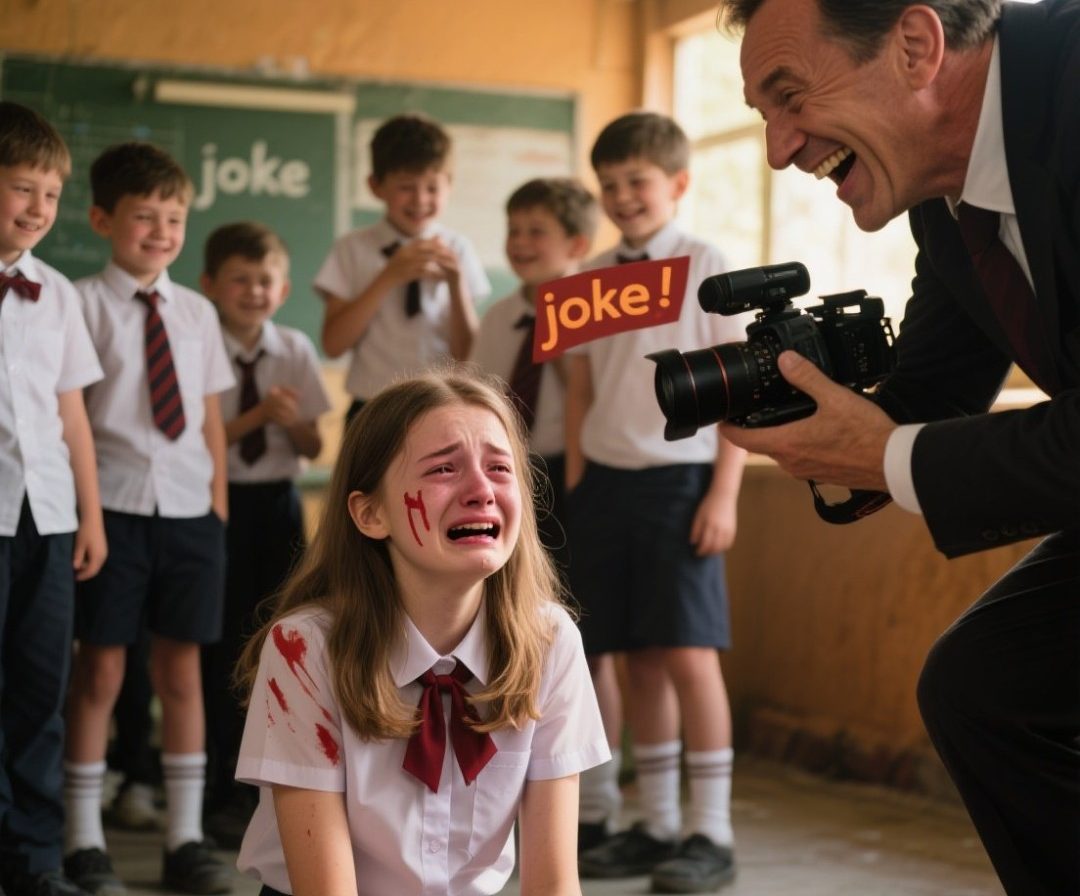
Instead, my seventeen-year-old daughter stood there coated head to toe in a thick, glossy layer of dark crimson industrial sealant—the kind meant to protect steel beams from corrosion, the kind with warning labels people ignore, the kind that eats skin if it lingers too long.
It hardened in her hair, soaked through her hoodie, and dripped slowly from her elbows onto the concrete like a grotesque imitation of blood. She was trembling, teeth chattering, eyes unfocused. When my hand twitched toward her, she flinched—not because she thought I’d hurt her, but because she was already braced for pain from anyone.
That flinch did something to me.
It woke a man I thought I’d buried.
“It’s paint,” she whispered, her voice cracking like the words themselves might break her. “They said it was a joke.”
The world tightened.
“Who,” I asked. The word came out flat, stripped of warmth, sharpened into a blade.
She swallowed. “Logan Whitmore. And his friends. They waited above the studio door. They filmed it. Everyone laughed.”
Logan Whitmore.
The mayor’s nephew. The donor’s kid. The boy whose last name unlocked doors that stayed welded shut for families like ours. I didn’t shout. I didn’t curse. Loud rage wastes energy.
I washed the chemicals from her skin slowly, carefully, watching clumps of hair fall away when the coating refused to release, watching her shoulders tense each time the solvent burned, watching her cry without sound because she didn’t want to be “dramatic,” because the system had already taught her pain was inconvenient.
Two hours later, after the damage was done, after the mirror reflected a stranger with uneven hair and raw, angry skin, she told me the part that mattered most.
“The principal laughed,” she said softly. “He said it was a prank. He told me to stop making a scene.”
That was when the past stopped staying buried.
Because once—long before I became a widower with grease under my nails and a daughter who drew to survive—I was Ethan Cross, Sergeant-at-Arms of the Black Anvil Brotherhood, the man whose job was to make sure consequences existed in a world where powerful people forgot they should.
I hadn’t worn my leather in public for nearly a decade.
That night, I took it out of the closet.

CHAPTER TWO – THE OFFICE THAT THOUGHT IT WAS UNTOUCHABLE
The front office of Ridgeway Academy smelled like money and disinfectant, a place where problems were smoothed over quietly and discomfort escorted off campus before donors noticed.
Principal Harold Beckett didn’t look up when I entered. Men like him believed eye contact was optional when they thought they were in control.
When he finally did, he smiled.
Not polite.
Not nervous.
Amused.
“You must be Emma’s father,” he said, waving vaguely. “Have a seat.”
“I’ll stand,” I replied, my voice calm enough to unsettle even me.
He leaned back, fingers laced. “Teenagers do foolish things. The boys meant no real harm.”
“She suffered chemical burns,” I said. “You sent her home without calling me.”
Beckett chuckled. Actually chuckled.
“Mr. Cross,” he said, adjusting his tie, “these families donate millions here. We can’t ruin futures over youthful exuberance. Your daughter should learn resilience.”
Resilience.
The word sat there, smug and empty.
“You laughed,” I said quietly.
He shrugged. “Perspective matters.”
I didn’t threaten him.
I didn’t raise my voice.
I simply left.
And when I reached my truck, I dialed a number I hadn’t called in years.
“Graves,” a voice answered.
“It’s Ethan,” I said. “We need to remind some people what accountability looks like.”
There was no pause.
“Say when.”

CHAPTER THREE – WHEN THE ROAD ANSWERS BACK
By sunrise, the street outside my house looked like a war memorial built from chrome and leather.
More than a hundred bikes lined the block, engines rumbling low, riders silent, disciplined, waiting.
Emma stood behind me on the porch, wrapped in a leather jacket stitched with PROTECTED across the back. Her breath hitched as she realized something fundamental had changed.
We rode to the school slowly, deliberately, taking up space the way power does when it stops asking permission.
Students froze.
Parents stared.
Phones rose.
When we arrived, Principal Beckett stepped forward, color draining as he recognized me, the patch, the fact that laughter carries consequences.
Emma dismounted, shoulders set, eyes forward.
I spoke to the crowd.
“My daughter is here to learn,” I said. “Anyone who thinks humiliation is entertainment should understand this clearly: she is not alone.”
Then came the turn.
One student stepped forward.
Then another.
Then dozens.
Phones lifted.
A recording played through portable speakers—Beckett’s voice, Logan’s father’s voice, laughing, discussing donations, discussing silence, discussing my daughter like acceptable collateral.
When truth finally escapes, it doesn’t whisper.
It roars.
Police arrived.
Federal agents followed.
Logan’s father tried to run.
He didn’t get far.
CHAPTER FOUR – THE NIGHT FIRE ANSWERED FIRE
We thought it was over.
We were wrong.
Three weeks later, my house burned.
Not an accident.
A message.
They came after us at night—quiet, professional, armed.
They didn’t expect the Brotherhood to respond faster than fear.
They didn’t expect my estranged brother, now a federal task officer, to drive a truck through my shop wall.
They didn’t expect engines to fill the street again.
They didn’t expect the girl they tried to break to stand, unflinching, behind concrete cover, trusting the people who showed up when it mattered.
The night ended with sirens, arrests, and the understanding that some wars aren’t chosen—they’re inherited.
EPILOGUE – WHAT REMAINS AFTER THE SMOKE
Six months later, Emma’s artwork hung in a downtown gallery—a massive canvas of a girl standing in fire while shadows formed a shield around her.
The title read “Still Standing.”
The principal was gone.
The donors were under investigation.
The boy who laughed transferred schools.
And my daughter?
She smiled again.