Her name was Laura Bennett, and until that night, she believed courage belonged to people with uniforms and medals.
It was just past 9:30 p.m. on a heavy summer evening in Savannah, Georgia. Laura, a 32-year-old physical therapy assistant, was walking home after a late shift when raised voices echoed near the corner of Bay and Jefferson. At first, she dismissed it—downtown noise was routine. Then she heard pain in the sound. Raw. Unmistakable. Panic.
A man stumbled into the street and collapsed beside a parked truck. He wore civilian clothes, but Laura recognized the posture instantly. Even injured, he tried to push himself up, scanning his surroundings with trained alertness. Blood soaked his shirt. A deep wound across his thigh looked like shrapnel or a blade.

Another man followed. Younger. Faster. A knife flashed beneath the streetlight.
Laura froze.
Every instinct screamed for her to run.
Instead, she stepped forward.
The injured man tried to rise again, but his leg gave out. The attacker lifted the knife. Laura moved between them without thinking, arms spread, voice trembling but steady.
“Stop.”
The knife fell.
She felt the first blow in her side—searing pain that stole her breath. Then another. And another. She screamed, but she didn’t back away. She seized the attacker’s wrist, twisting with everything she’d learned helping patients regain movement. The blade slipped, slicing her forearm. The man cursed and struck again.
Seven times.
By the time the attacker fled, spooked by approaching sirens, Laura collapsed beside the wounded man, blood pooling beneath them both.
Police arrived within minutes. Paramedics followed. As they lifted her onto the stretcher, Laura heard one EMT murmur in disbelief, “She shielded him.”
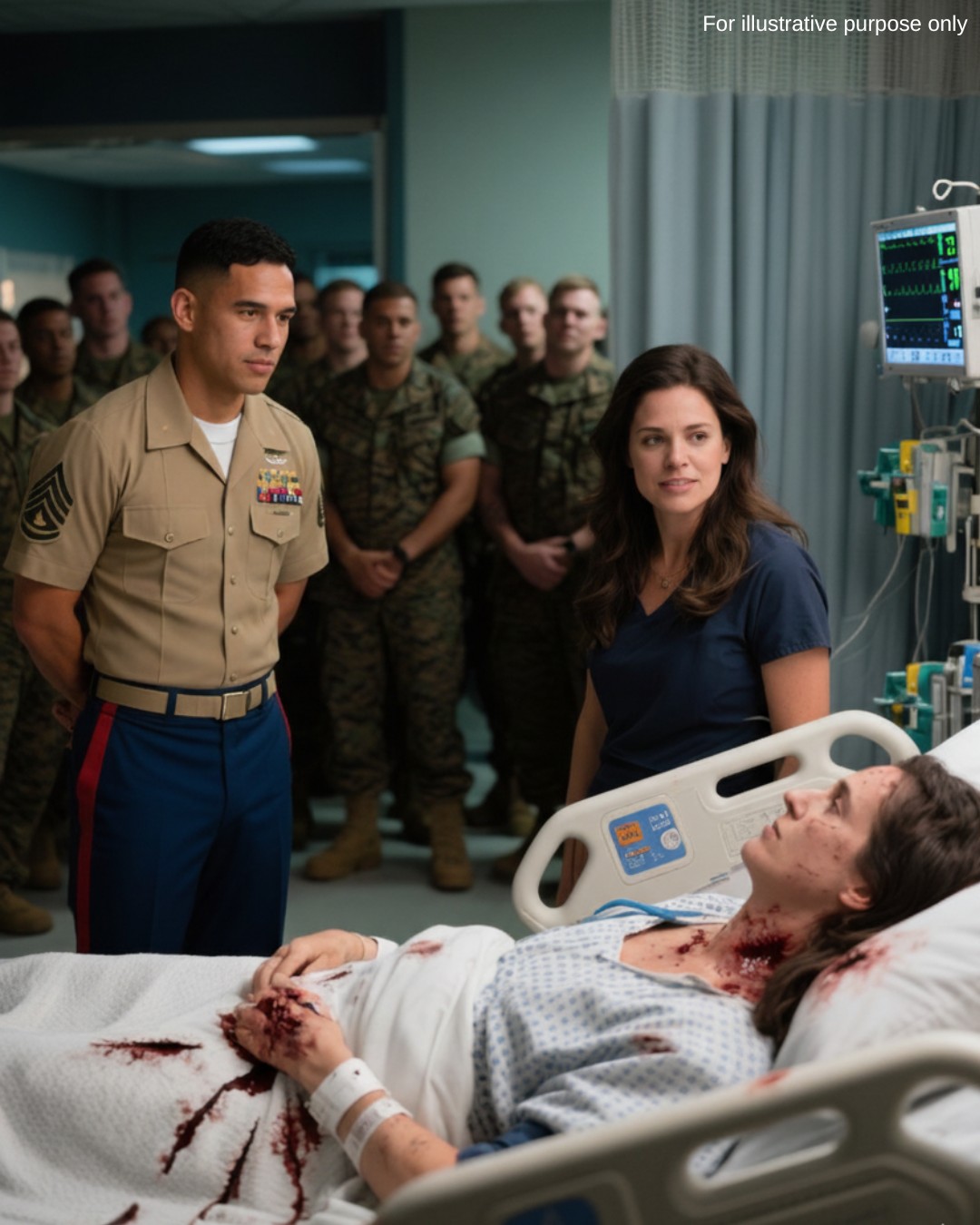
At the hospital, doctors worked for hours. She’d lost a dangerous amount of blood. Two punctured lungs. A fractured rib. Internal bleeding narrowly avoided.
The man she saved—Staff Sergeant Daniel Reyes, United States Marine Corps—survived because of her.

Laura drifted in and out of consciousness, unaware that by morning, something extraordinary was already unfolding.
Because when a Marine’s life is saved…
…the Corps never forgets.
And at dawn, a knock would come for Laura Bennett—one that would change her life forever.
Who was on the other side—and why were they in uniform?
The sun had barely begun to rise over the Savannah skyline when the sterile quiet of the ICU was broken by an unexpected sound: the synchronized, deliberate thud of heavy boots on linoleum.
Laura was awake—barely. Every breath felt like pulling air through a crushed straw, her chest bound tightly in bandages. Her mother, dozing in the bedside chair, jolted upright as the heavy door slowly opened.
It wasn’t a doctor.
It wasn’t a nurse.
A man stood there in Dress Blues, the uniform so crisp its creases looked sharp enough to cut glass. He was tall, silver-haired, with the eagles of a Colonel on his shoulders. Behind him, filling the hallway like a wall of blue and gold, stood twenty Marines.
The Colonel stepped inside, removed his cover, and tucked it beneath his arm. He didn’t speak right away. He simply regarded the pale, bruised woman in the bed with a level of respect usually reserved for senior officers.
“Ms. Bennett,” he said, his voice a low rumble that seemed to vibrate the IV poles. “I am Colonel Miller. I command the unit Staff Sergeant Reyes belongs to.”
Laura tried to respond, but a cough seized her, sending pain through her ribs. She settled for a faint nod.
“Daniel is in surgery three floors below,” the Colonel continued. “The doctors say he’ll walk again because you didn’t run. Because you stood your ground when a trained soldier couldn’t.”
He turned slightly and gestured toward the hallway. The Marines weren’t there only for formality. They carried boxes of supplies, armfuls of flowers bright to the point of absurdity, and a framed photograph.
“The Corps has a saying,” the Colonel said, leaning closer. “Semper Fidelis. Always Faithful. It’s a promise we make to each other. But last night, you made that promise to a stranger. You bled for one of our own. To us, that makes you family.”

One by one, the Marines entered the room. They didn’t offer empty words. Instead, they moved with quiet purpose. They checked on her mother, offering coffee and a phone number.
“Anything you need,” a young Corporal whispered. “Groceries, rides, home security—anything. You don’t pay for a thing until she’s back on her feet.”
But it was the final gesture that undid Laura.
The Colonel reached into his pocket and produced a small, weighty bronze disc—a Challenge Coin. He pressed it into her palm, her trembling fingers closing around the cold metal.
“This isn’t a gift,” Miller said firmly. “It’s a mark of membership. You stood in the gap when the world went dark, Laura. From this morning on, you will never walk alone again. If you ever need a hand, a shoulder, or a shield, you call the United States Marine Corps. We’re at your doorstep because you were at his.”
As the Marines filed out and took positions in the hallway—making it clear no one, not the press or the curious, would interrupt her rest—Laura looked down at the coin.
She had been a physical therapy assistant who thought bravery belonged to other people. But as the emblem of “The President’s Own” caught the morning light, she understood she hadn’t only saved a life. She had gained a brotherhood of thousands.
The pain remained, and the recovery would be long. But for the first time since the knife flashed beneath the streetlights, Laura Bennett wasn’t afraid. She closed her eyes, listening to the steady, measured steps of the sentry outside her door—guarding the woman who had guarded a Marine.