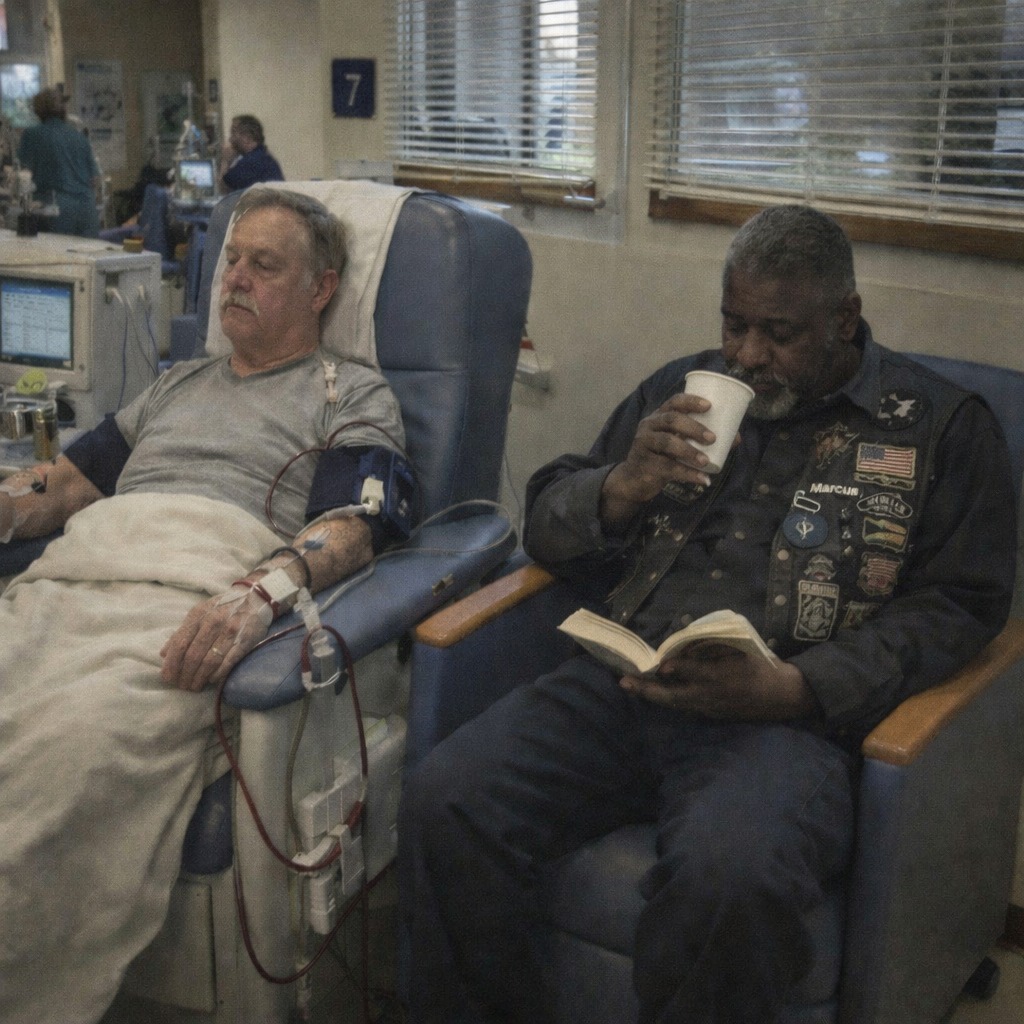
I have no family, no car; but this biker has driven me to dialysis 3 times a week for 4 years.
His name is Marcus. He’s 58. He drinks his coffee black. He reads historical fiction. He works night shifts as a hospital custodian so he can be here during my morning sessions.
He’s never missed once.
Not for holidays. Not for bad weather. Not when the center was barely open during a blizzard. Marcus was there.
My family stopped coming after the second month.
My daughter came twice. Then her kids had activities. Then it was too far. Then she stopped calling to explain.
My son came once. Sat for twenty minutes checking his phone. Left before my session was done. Haven’t seen him since.
My ex-wife sent flowers on my birthday. They died before I got home from the hospital.
But Marcus shows up.
I didn’t understand it at first. Thought he was confused. Thought he was waiting for someone else. When I realized he was there for me, I thought he was crazy.
“Why are you here?” I asked him after the third week.
“To keep you company.”
“I don’t know you.”
“Not yet.”
That was four years ago. Now I know his coffee order, his favorite authors, the names of his two grown kids. I know he’s a widower. I know he’s a veteran. I know he volunteers at three different places because staying busy keeps the grief away.
But I still don’t know why he chose me.
The dialysis center has maybe thirty regular patients. Some have family who visit. Most don’t. There are at least a dozen people who sit alone every session, staring at the TV or sleeping through the four hours.
Marcus could have picked anyone. But he picked me.
He brings breakfast sometimes. Nothing fancy. A muffin. A bagel. Things I can eat with my kidney restrictions. He researched my diet without me asking.
He brings books and reads out loud if I’m too tired to read myself. He brought a deck of cards and taught me gin rummy. We’ve played probably 500 games. He’s winning by sixty-three.
When I had a bad reaction to treatment last year and my blood pressure crashed, Marcus was the one who held my hand while the nurses worked. My emergency contact is my daughter. She didn’t answer. But Marcus was there.
The nurses think he’s my brother. I’ve stopped correcting them.
Last week was my four-year anniversary on dialysis. Four years of needles and machines and watching my blood cycle through tubes. Four years of my kidneys failing a little more each month. Four years of wondering if I’ll make it to a transplant list.
Marcus brought a card. He’s not a card guy. But he brought one anyway.
Inside it said: “Four years of fighting. I’m honored to witness it.”
I asked him why he does this. Why he spends twelve hours a week sitting in a medical clinic with someone he didn’t know four years ago.
“You don’t have to keep coming,” I said. “I’ll be okay.”
Marcus looked at me for a long time. Then he said something I wasn’t expecting.
“When my wife was on dialysis, I sat with her every session. For two years. Right up until the end. She died waiting for a kidney that never came.”
“I’m sorry.”
“After she died, I couldn’t stay away from this place. I kept coming back. The nurses asked if I wanted to volunteer. Sit with patients who don’t have anyone.”
“So you picked me?”
“I picked you because the first day I saw you, you were reading the same book she’d been reading when she died. Same exact book. Same bookmark placement. I know because I finished it for her.”
I looked down at the book in my lap. Historical fiction about World War II. I’d bought it at a thrift store.
“I thought it was a sign,” Marcus said. “That maybe I was supposed to be here. For you.”
That was a week ago. I haven’t known what to say since.
But yesterday, something happened that made me understand why Marcus really comes. And it wasn’t about his wife. It wasn’t about the book.
It was about something else entirely. Something he’d been carrying for four years. Something I’d never suspected.
Yesterday started like every other Tuesday. Marcus was already there when they called me back. Chair 7. He’d saved the visitor seat with his jacket.
“Morning, James,” he said. That’s my name.
“Morning.”
The nurse got me set up. Two needles, one in each arm. Blood out, blood back in. Four hours of sitting while a machine does what my kidneys can’t anymore.
Marcus pulled out a book. Different one this time. He’d finished the WWII novel two weeks ago.
“What’s this one about?” I asked.
“Korean War. Memoir. Guy was a medic.”
“Any good?”
“Just started. I’ll let you know.”
We settled into our routine. Marcus read. I watched the numbers on the machine. The minutes ticking by. My blood pressure. My fluid removal rate.
Halfway through the session, a woman came into the dialysis center. She was maybe thirty. Blonde hair. Professional clothes. She looked lost.
She spoke to the front desk. The receptionist pointed toward my section.
The woman walked over. Stopped at my chair.
“James Morrison?” she asked.
“That’s me.”
“My name is Dr. Sarah Kellerman. I’m with the transplant center at University Hospital. Can I speak with you for a moment?”
My heart jumped. “Did you find a match?”
“Can we talk privately?”
Marcus started to stand. I grabbed his arm. “He can stay. Whatever you need to say, he can hear it.”
Dr. Kellerman looked at Marcus, then at me. “All right. Mr. Morrison, we have a kidney for you.”
The world stopped.
“What?”
“A donor kidney became available. You’re a match. We need to get you to the hospital immediately.”
Four years. Four years of waiting. Of hoping. Of watching other patients get called and wondering if my turn would ever come.
“I don’t understand,” I said. “I thought I wasn’t high enough on the list.”
“You’re not on the general list. This is a directed donation. The donor specifically requested you.”
“I don’t know anyone who’d donate to me. My family won’t even visit.”
Dr. Kellerman glanced at Marcus again. “The donor prefers to remain anonymous. But they’ve been tested, cleared, and they’re ready. We can do the surgery tomorrow morning if you’re willing.”
“If I’m willing? Yes. Of course. Yes.”
“Good. I need you to come with me now. We’ll run some final tests and prep you for surgery.”
The nurse started unhooking me from the machine early. My head was spinning.
Marcus stood up. “Congratulations, James.”
“I can’t believe this is happening.”
“You deserve it. You’ve fought hard.”
Dr. Kellerman was filling out paperwork. Talking to the nurses. Everything was moving so fast.
I looked at Marcus. “Will you come? To the hospital?”
“I don’t think they allow visitors before surgery.”
“I don’t care. I need someone there. Please.”
Marcus nodded. “I’ll be there.”
They took me to University Hospital. Ran blood work. Did scans. Checked everything twice. The kidney was healthy. The match was good. Surgery was scheduled for 6 AM.
Marcus showed up at 8 PM. Visiting hours were over but he told them he was my brother. They let him in.
He sat in the chair next to my hospital bed. Same as always.
“How are you feeling?” he asked.
“Scared. Excited. I can’t believe someone would do this for me.”
“People are capable of amazing things.”
“Do you know who it is? The donor?”
“Why would I know?”
“I don’t know. It just seems strange. The timing. After four years, suddenly there’s a kidney and it’s directed specifically to me?”
Marcus didn’t answer right away. He looked at his hands.
“James, there’s something I need to tell you.”
Something in his voice made my chest tighten. “What?”
“The reason I’ve been coming to your dialysis sessions. It wasn’t just about the book. That was part of it. But there’s more.”
“I don’t understand.”
He took a deep breath. “Eight years ago, I made a mistake. I was driving home from work. It was late. I was tired. I looked down at my phone for just a second.”
My stomach dropped.
“When I looked up, I’d drifted into the other lane. There was a car coming. I swerved back but I clipped them. Sent them off the road.”
I couldn’t breathe.
“The driver survived. But she was hurt badly. Internal injuries. By the time the ambulance got there, she’d lost a lot of blood. They rushed her to surgery but the damage was too severe. Her kidneys failed. Acute kidney injury that became chronic.”
“Marcus—”
“I stayed at the hospital. Waited to see if she’d be okay. The police came. Took my statement. I told them everything. Said it was my fault. They cited me for distracted driving. I lost my license for a year. Had to do community service. Pay a fine.”
“Why are you telling me this?”
“Because the woman I hit was named Jennifer Morrison. Your wife.”
The room tilted.
“What?”
“I’m the reason she needed a kidney transplant. I’m the reason her health fell apart. I’m the reason she spent two years on dialysis before she died.”
I stared at him. At this man who’d sat with me for four years. Who’d never missed a session. Who’d brought me coffee and played cards and held my hand when I was scared.
“You killed my wife.”
“Yes.”
“And you’ve been sitting with me for four years? Why? Guilt?”
“At first, yes. I went to Jennifer’s funeral. Saw you there. Saw how destroyed you were. I wanted to apologize but I couldn’t find the words.”
“So you just showed up at my dialysis?”
“I found out you’d developed kidney disease. Asked around and learned you were alone. No visitors. No support. And I thought—I thought maybe I could do something. I couldn’t bring her back but I could make sure you didn’t go through it alone like she did.”
I wanted to be angry. I wanted to scream at him. Tell him to get out. Tell him I never wanted to see him again.
But I thought about the last four years. Every Tuesday, Thursday, Saturday. Every coffee. Every conversation. Every moment he’d been there when no one else was.
“Does my family know?” I asked. “Do they know you’re the one who hit her?”
“No. I never told anyone. The accident report has my name but I don’t think anyone ever looked.”
“Why are you telling me now?”
Marcus reached into his pocket. Pulled out a hospital bracelet.
“Because I’m your donor, James. I’m giving you my kidney tomorrow morning.”
The world stopped again.
“What?”
“I’ve been tested for two years. Waited until I was cleared. Made sure I was a match. Asked the transplant center to keep it anonymous until after you agreed.”
“You’re giving me your kidney.”
“Yes.”
“Why?”
“Because I took your wife’s kidneys. And now I want to give you mine. It won’t bring her back. It won’t undo what I did. But maybe it’ll give you a chance at a life. A real life. Not just four hours in a chair three times a week.”
I couldn’t process it. Couldn’t make sense of it.
“I don’t know what to say.”
“You don’t have to say anything. You can refuse. You can tell them you want a different donor. You can tell me to leave and never come back. But I need you to know—I’ve been here for four years because I owe you. I owe her. And this is the only way I know how to pay that debt.”
We sat in silence. The hospital sounds filled the space between us. Machines beeping. Footsteps in the hallway. Distant conversations.
Finally, I spoke. “Did you love her? Jennifer?”
“I didn’t know her. I only saw her for a second before the crash. But I’ve thought about her every day for eight years. I’ve visited her grave. I’ve talked to her. Apologized to her. Promised her I’d take care of you.”
“She’d probably think this was insane.”
“Probably.”
“She’d also probably think it was the right thing to do.”
Marcus looked up. “What?”
“Jennifer believed in redemption. She believed people could change. Make amends. She would’ve forgiven you years ago.”
“I don’t know if I can forgive myself.”
“Then do the surgery. Give me your kidney. And maybe that’s how you start.”
They took us into surgery at 6 AM. Me in one room. Marcus in another.
I don’t remember much after the anesthesia. Just white lights and voices and the feeling of drifting.
When I woke up, it was afternoon. A nurse was checking my vitals.
“How do you feel?” she asked.
“Tired. Sore.”
“That’s normal. The surgery went well. Your new kidney is already functioning.”
“Where’s Marcus? The donor?”
“He’s in recovery. He’s doing fine.”
“Can I see him?”
“Not yet. But soon.”
They kept me in the hospital for five days. Standard for transplant patients. They monitored the kidney. Made sure my body wasn’t rejecting it. Adjusted my medications.
Marcus was there two days longer. Kidney donation is major surgery. They’d taken one of his organs. He’d need time to heal.
On the third day, they wheeled me to his room. Let us visit for a few minutes.
He looked pale. Tired. But alive.
“Hey,” I said.
“Hey.”
“They tell you it’s working? The kidney?”
“Yeah. They said it’s functioning perfectly.”
“Good.”
We didn’t talk about the accident. Didn’t talk about Jennifer. We just sat there. Two men connected by tragedy and surgery and four years of Tuesday, Thursday, Saturday mornings.
“Thank you,” I finally said.
“You don’t have to thank me.”
“Yes I do. You gave me my life back.”
“I took your wife.”
“And you spent four years making sure I didn’t give up. That counts for something.”
Marcus closed his eyes. “I don’t know if I’ll ever feel like I’ve done enough.”
“Then I guess you’ll just have to keep showing up.”
He smiled at that. Just a little.
It’s been six months since the transplant. My kidney function is normal. I don’t need dialysis anymore. I wake up every morning and I’m not exhausted. I can eat what I want. Drink water without measuring every ounce. Live.
Marcus still shows up. Not three times a week anymore. But he calls. We meet for coffee. Play gin rummy. He’s still winning.
My daughter came to visit last month. First time in four years. She cried when she saw me. Said she was sorry for not being there. Sorry for missing so much.
I introduced her to Marcus. Told her he was a friend. Told her he’d been there through everything.
I didn’t tell her about the accident. About what he’d done. About the kidney.
Maybe someday I will. Maybe someday she needs to know that the man who killed her mother also saved her father.
But for now, it’s enough that he’s here.
Marcus says he still visits Jennifer’s grave. Still talks to her. Still apologizes.
I went with him last week. First time I’d been there since the funeral.
We stood at her headstone. Marcus on one side. Me on the other.
“I’m taking care of him,” Marcus said to her. “Like I promised.”
I put my hand on the stone. “He’s taking care of me too. I think you’d like that.”
We stayed for an hour. Then we went and got terrible coffee at the diner near the cemetery.
Marcus paid. Like he always does.
“You know you don’t have to keep doing this,” I said. “You’ve paid your debt. You gave me a kidney. You’ve given me four years of your life. You don’t owe me anything anymore.”
“I know,” Marcus said. “But I’m not doing it because I owe you. I’m doing it because you’re my friend.”
And that’s the truth of it. Somewhere between the guilt and the grief and the gift of an organ, we became friends.
I don’t know if that’s redemption. I don’t know if that’s forgiveness. I don’t know if Jennifer would approve or if the universe balances these scales or if any of it makes sense.
All I know is that a stranger showed up when no one else would. And he’s still showing up. Not out of obligation. But because that’s what people do for each other when they choose love over guilt. Connection over isolation. Showing up over walking away.
My family didn’t come to my dialysis for four years. But Marcus never missed once.
And now I understand why. He wasn’t there to ease his guilt. He was there because broken people can still show up for each other. And sometimes showing up is how we heal. Both of us. Together.
Tuesday, Thursday, Saturday mornings. We don’t spend them in Chair 7 anymore. But we spend them together. Coffee. Books. Gin rummy.
And that’s enough.
That’s more than enough.
That’s everything.