My name is Lena Holloway, and until I turned thirty-two, I believed survival meant endurance, that loyalty required silence, and that family—no matter how cutting its edges—was something you learned to navigate carefully, like a cracked staircase you climbed every day without ever asking why it was broken to begin with.

I was wrong about all of it, though I didn’t understand just how wrong until the night my father chose a hospital room—washed in antiseptic light and punctuated by half-beeping machines—as the setting for what he believed was the final act of control over my life.
The surgery itself had been sudden, brutal in the way emergencies always are, because pain doesn’t ask permission and fear doesn’t give warning. When I woke hours later, my head thick with fog and a burning line of stitches stretched across my abdomen, all I wanted was quiet, a few hours of sleep, maybe a future that didn’t feel like it was constantly bargaining with disaster.
I didn’t expect my phone to buzz, and I certainly didn’t expect the name Victor Holloway on the screen, because even in that weakened moment I knew instinctively that nothing good ever followed his voice.
“Pay the rent or get out,” he barked before I could say hello, the words crashing through the speaker like a threat repeated so often it no longer needed explanation.
“Dad,” I whispered, my throat raw, my hands shaking as I shifted against the stiff hospital pillow, “I’m still in recovery, I literally just came out of surgery today, I—”
“So now you think you’re better than this family?” he sneered, that familiar blend of contempt and wounded pride dripping from every syllable, as if my pain weren’t medical fact but a personal insult meant to inconvenience him.
For most of my life, I would have apologized right there, would have folded myself into whatever shape ended the conversation fastest, because growing up under Victor’s roof taught me early that peace was earned by shrinking. But something about the hospital room—the sterile walls, the quiet authority of the machines keeping me alive—made his voice sound suddenly smaller, less inevitable, and for the first time I tried to explain instead of surrendering.
“I can’t even stand without help,” I said quietly, measuring each word, “I just need a little time.”

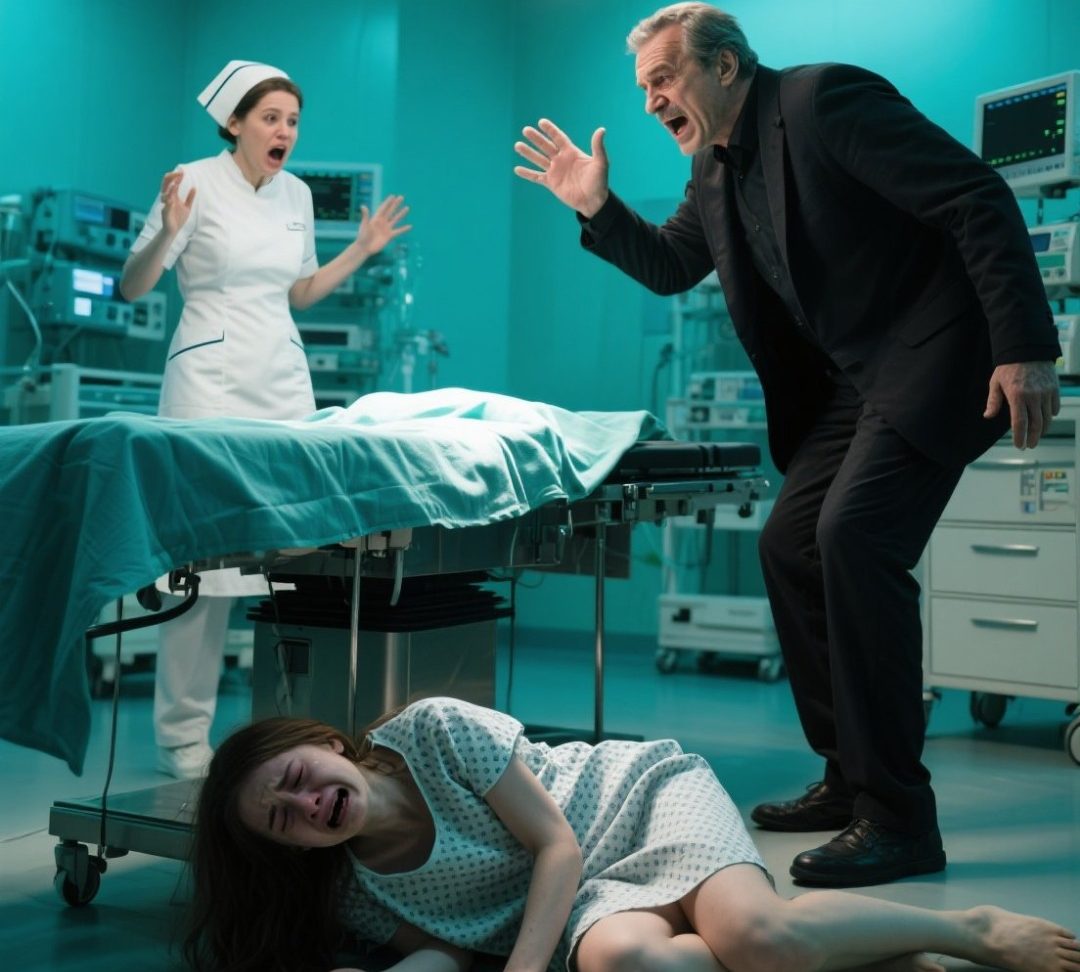
The silence on the line barely lasted a second before my door flew open with enough force to make the nurse at the station flinch. Victor stood there like he owned not just the room but the air inside it, jaw tight, eyes sharp with an anger rooted not in the moment but in years of entitlement finally being questioned. “You don’t get time,” he snapped, stepping closer, his phone still clenched in his hand as if the argument had only changed location, not nature. I remember thinking, absurdly, how out of place he looked among IV poles and soft lighting, like a relic from a harsher world that had wandered into a space built for care.
I opened my mouth to speak, to reason, to defuse things the way I always had, but he moved faster than I expected. His palm struck my cheek in a sharp, stunning motion that stole the air from my lungs and sent me sliding off the bed, pain flashing white behind my eyes as I hit the floor.
The sound I made wasn’t a scream so much as a gasp, and for a split second the room froze, as if reality itself needed time to register what had happened. Then everything exploded at once. A nurse shouted, the emergency button was slammed, footsteps thundered down the hallway, and I lay on the cold floor staring at ceiling tiles, thinking not about the pain but about how strange it felt to see my father’s behavior mirrored in other people’s horrified faces.
When security rushed in, followed by two police officers nearby for an unrelated call, they stopped short, their expressions shifting from confusion to disbelief as they absorbed the scene: a grown man rigid with rage, a woman in a hospital gown curled on the floor clutching her face, blood marking fabric near stitches that should never have been strained.
Victor stepped back then, as if witnesses had finally caught up with him, his bravado cracking, his voice dulling. “I didn’t mean it like that,” he muttered, already reaching for excuses as he always had. “She just doesn’t listen.”
But something unexpected happened in that moment—something that redirected my entire life—because instead of collapsing inward the way I had for decades, a strange calm settled over me, a clarity cutting through fear and pain like light through fog.
“I didn’t provoke him,” I said, my voice shaking but steady as an officer helped me sit up, and the words felt heavier than anything I’d ever said to him before, because they were true and I wasn’t apologizing for them.
The officers exchanged a glance. One stepped subtly between Victor and me while the other asked him to show his hands, and for the first time I watched my father understand that his authority ended where his intimidation stopped.
As they led him out, his protests fading with each step, something lifted from my chest, replaced by a sensation I would later recognize as safety.
The staff checked my vitals, confirmed my stitches were intact, and spoke with a gentleness that felt unfamiliar. When a social worker named Marissa Klein arrived later that night carrying not judgment but options, I realized how small my world had been for so long.

She talked about restraining orders, emergency housing, trauma counseling, and for the first time none of it was framed as overreaction or betrayal, but as reasonable responses to unacceptable behavior. Somewhere between the paperwork and her quiet reassurance, a truth settled in that I couldn’t ignore.
Victor hadn’t just been angry that day—he’d been angry my entire life, and I’d been managing his emotions at the cost of my own since childhood.
The twist came two days later, after he was formally charged with assault, when a detective returned with questions not just about that incident, but about patterns—financial control, the rent Victor demanded even though my apartment was partly funded by an inheritance my mother left me, money that had quietly vanished years earlier.
As we spoke, timelines aligned, inconsistencies sharpened, and what began as a single act of violence unraveled into a wider investigation involving fraud, coercion, and years of psychological abuse that had never been recorded because no one had ever asked the right questions.
Weeks later, when my older brother Caleb—who’d left home at eighteen and rarely looked back—appeared at my temporary apartment, his apology carried unexpected weight. Leaving hadn’t protected me the way he’d hoped, but it hadn’t erased the damage either.

We talked for hours, not about fixing the past, but about building something healthier ahead, and for the first time family felt like a choice, not a sentence.
I didn’t reconcile with Victor, and I didn’t need to. Healing didn’t require his understanding, only my boundaries. As I rebuilt my life—slowly, deliberately, with help—I learned that strength isn’t loud, survival isn’t submission, and sometimes the most powerful moment comes not when you fight back, but when you finally stop accepting what should never have been tolerated at all.