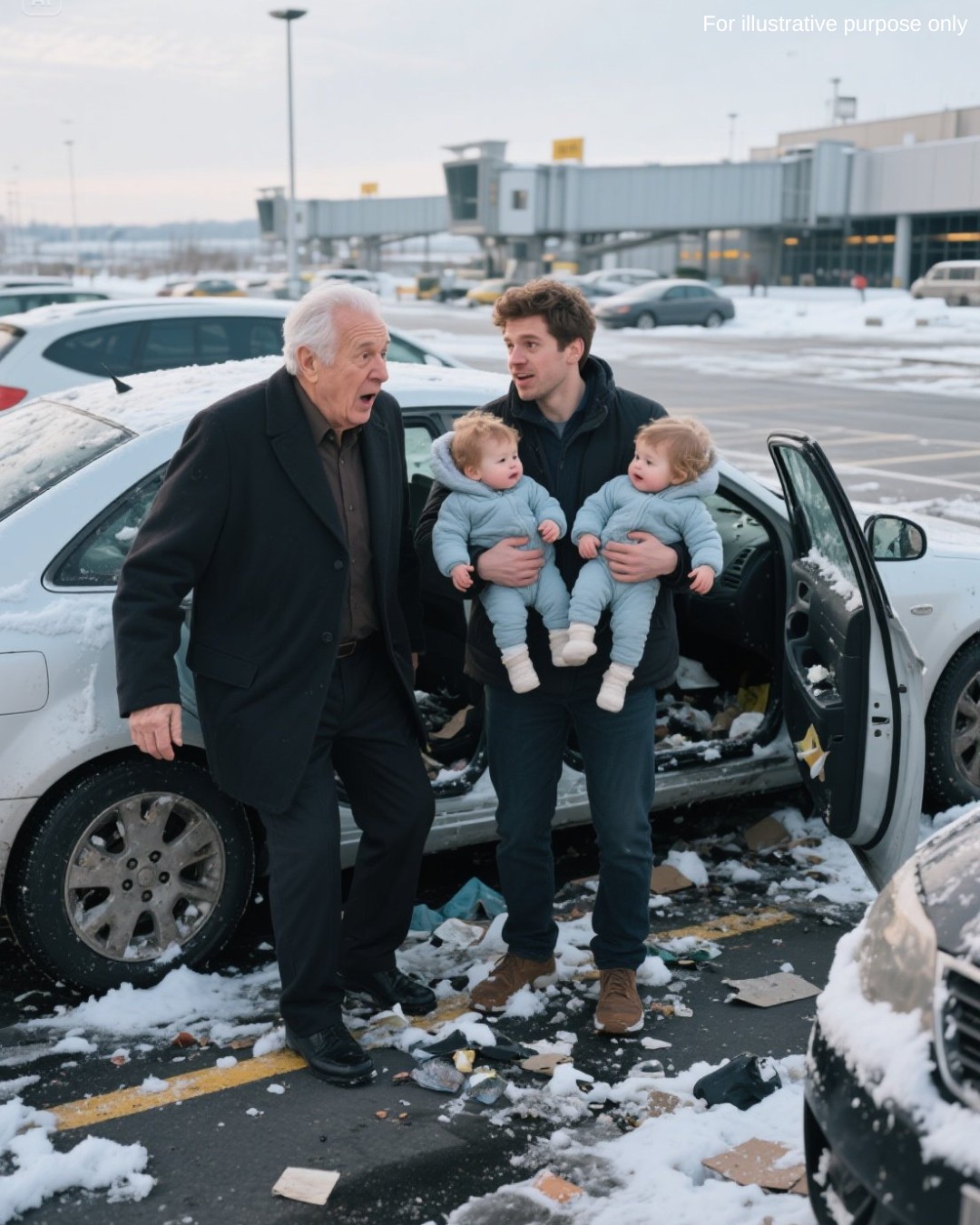
At an airport parking lot, I discovered my son sleeping in his car with his twin boys. I asked him, “Where is the $150K I invested in your startup?” He collapsed in tears. “My wife and her family took everything and said I’m mentally unstable.” Rage surged through me. “Pack your things. We’re fixing this now.”
The sharp March wind sliced through the Toronto Airport parking lot. I had arrived on a red-eye, carried by the warm idea of surprising my son, Michael, for his birthday. But as I walked through the rows of the cheapest long-term parking, I suddenly stopped.

A Honda Civic sat alone at the far edge. It wasn’t the car itself—it was the windows. They were heavily fogged from the inside, a clear sign that people had been breathing in that tight space far too long in the cold. A sick feeling tightened my stomach. I stepped closer and looked through the haze. My heart didn’t just stop—it dropped.
It was Michael, slumped behind the wheel. But the back seat broke me. Curled beneath a single thick blanket, surrounded by fast-food wrappers, were my grandsons, Nathan and Oliver.
I tapped on the glass. Michael jolted awake with the wild fear of a cornered animal, which quickly collapsed into crushing shame when he saw me.
“Dad?” His voice was rough, barely holding together.
“Why are you living in a car with my grandsons?” I demanded, my voice splitting.
An hour later, sitting in a corner booth, the truth spilled out. Michael looked hollow, clinging to a cup of coffee like it was keeping him alive. “She tricked me into signing over the assets, changed the locks, and got a restraining order saying I was ‘unstable.’ Her family has money, Dad. They have power. I lost the house, my business… I can’t fight them.”
As I watched my son unravel, shock gave way to a cold, deliberate fury. I reached across the table and took his wrist. “Maybe you can’t right now. But we can.”
That night, after the boys fell asleep in the hotel suite—safe in real beds—I opened my laptop. I wasn’t just a retired grandfather. I was a man with thirty years of business connections and zero patience for bullies. I called my corporate attorney.
“I need the name of the most aggressive, ruthless family law attorney in Ontario,” I said, my voice steady as steel. “Money is not an issue. I don’t want a mediator. I want a wartime consigliere.”
They thought they had destroyed him. They believed he was alone, weak, and broke.
They forgot one thing: he wasn’t an orphan. By morning, shock had hardened into resolve.
Michael sat at the small hotel desk, staring into space, while I watched my grandsons eat cereal on the bed—quiet, cautious, as if afraid to take up space in a world that had already taken too much from them. No child should learn silence so early.
That’s when I knew this was no longer just about money.
The attorney called back before noon. Her name was Margaret Hale—her reputation sharp enough to make judges brace themselves. When she heard the outline of the case, she didn’t offer comfort. She offered strategy.
“False instability claims are common,” she said coolly. “But they’re sloppy when arrogant people weaponize them. If your son is willing to fight, we can dismantle this.”
Michael hesitated. I saw the fear return—the fear of retaliation, of losing what little access he still had to his children, of being crushed all over again. I placed my hand on his shoulder.
“They already took everything,” I said quietly. “The only thing left to lose is the lie.”
That afternoon, we started.
Bank statements. Emails. Texts. The startup paperwork I had helped fund—signed under “temporary mental distress,” words that now looked like a trap in hindsight. Margaret’s team worked with surgical precision, stripping away the story his wife’s family had built.
Then the first fracture appeared.

A therapist’s report—used to justify the restraining order—was based on a single phone call, scheduled and paid for by his wife’s brother. No evaluation. No diagnosis. Just a suggestion inflated into a weapon.
“Judges hate this,” Margaret said, a thin smile crossing her face. “It stinks of manipulation.”
Within a week, an emergency motion was filed.
Michael didn’t sleep the night before the hearing. Neither did I. At dawn, I watched him tie his knot with shaking hands. He looked like a man walking back into a burning house—not to save possessions, but to reclaim his name.
In court, his wife wouldn’t meet his eyes. Her parents sat behind her, polished and confident, like this was another deal they expected to win.
They didn’t expect me.
When Margaret asked to address the court about the startup funds, she introduced me not as a father—but as an investor. One with records. One with leverage. One who did not tolerate fraud disguised as family conflict.
The judge leaned forward.
By the time we left the courthouse, the restraining order had been temporarily lifted, supervised visitation restored, and a full forensic review ordered into the asset transfer.
It wasn’t a victory.
But it was something far more dangerous.
Momentum.
That night, as Michael tucked his sons into clean sheets, Nathan looked up and asked, “Daddy… are we going home now?”

Michael swallowed, then answered with something I hadn’t heard from him in a long time.
“Soon,” he said. “And this time—we’re not leaving.”
Across the city, powerful people were beginning to understand their mistake.
They thought they had isolated a man.
They hadn’t realized they had awakened a family.
And this time—
we were done being quiet.